Inquiry Ordered and Arrests Made Following Fatal Fire in Lucknow
At least 15 people died after a fire trapped employees and trainees inside a building lacking emergency exits in northern India.

World correspondent
Reports on international affairs, diplomacy, and humanitarian developments with an emphasis on official statements, multilateral institutions, and regional context.
Editorial responsibility: Lead reviewer for geopolitics, international institutions, and crisis coverage
Primary source: BBC World News. Full source links and update notes are below.
Fast summary
Start here
- An official inquiry has been launched into the fire that killed 15 people in Lucknow.
- Four individuals have been arrested and four public officials suspended following safety violations.
- The building, housing an animation center and pet shop, lacked proper emergency exits and fire safety measures.
What happened
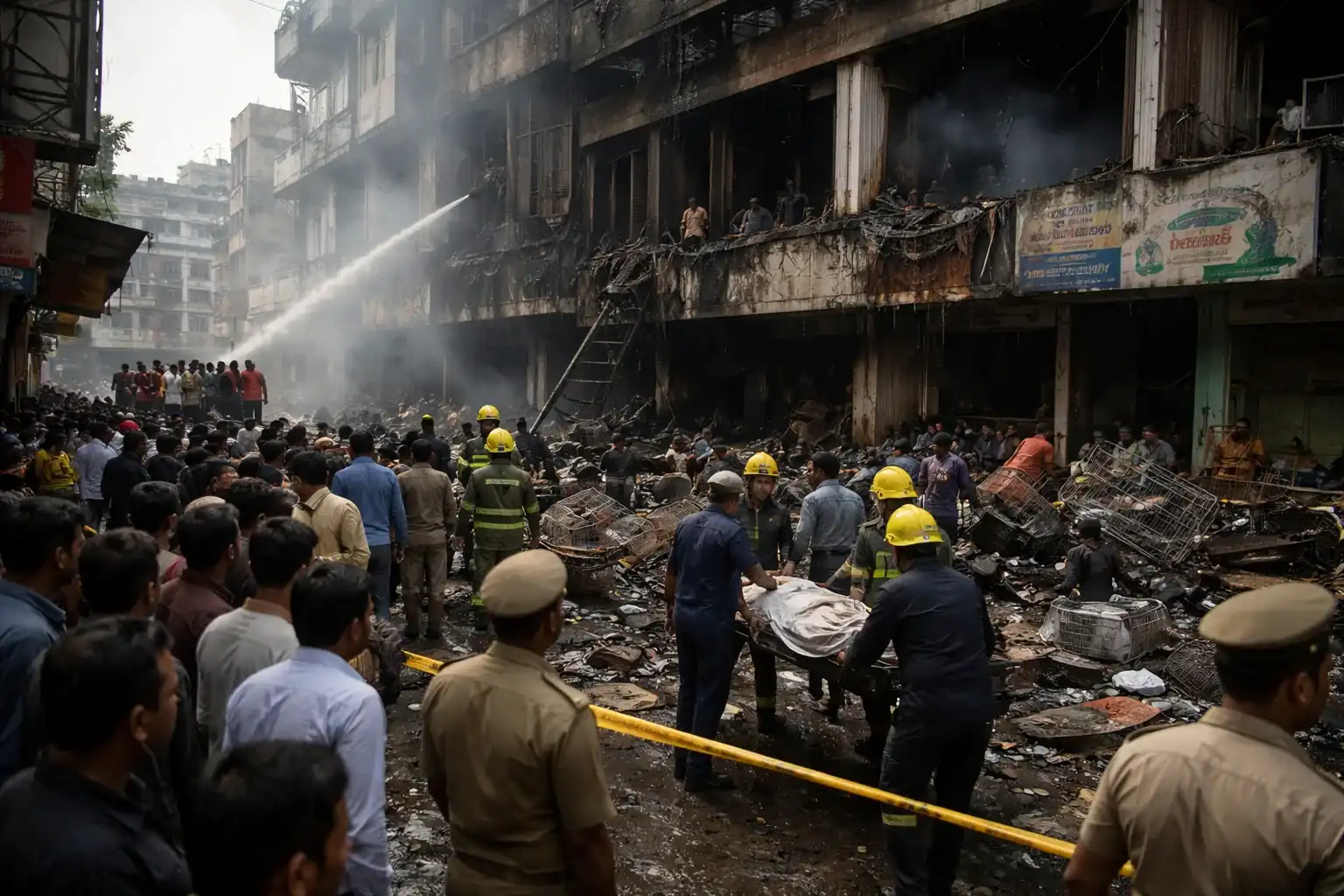
Authorities in Lucknow have ordered an inquiry after a building fire killed at least 15 people in the north Indian city, with arrests and official suspensions following early evidence of serious safety failures. The commercial structure reportedly housed a pet shop on the ground floor and training or office activity above, where smoke and blocked escape routes trapped workers and trainees as the fire spread.
The immediate human toll is severe on its own, but the story has grown larger because it appears to fit a familiar and deeply damaging pattern in India: buildings operating without adequate fire safety, emergency exits, or enforceable compliance despite obvious risks in dense urban environments.
Why the inquiry matters
Public inquiries after fatal fires can sometimes become procedural rituals, but in this case the investigation matters because the early details point to multiple possible layers of negligence. Reports that the building lacked proper emergency exits and that the staircase became unusable suggest the victims may have had little realistic path to escape once smoke filled the structure.
That changes the meaning of the tragedy. The question is not only how the fire started. It is whether the building was functionally unsafe before the first spark.
The role of arrests and suspensions
The arrests of several individuals and the suspension of public officials show that authorities understand the political sensitivity of the case. Fatal building fires often trigger anger not simply because they happen, but because families suspect the disaster was preventable and that officials ignored obvious violations until people died.
Those actions do not resolve responsibility by themselves, but they signal that the state cannot treat the incident as a simple accident without broader scrutiny. In cases like this, enforcement history matters almost as much as the fire's immediate cause.
Why witnesses' accounts are important
Reports of people jumping from windows, struggling through smoke, or trying desperate escape methods point to a building that failed under stress in the worst possible way. When survivors and relatives describe blocked exits, inaccessible stairs, or systems that may have slowed evacuation, they are describing the practical difference between regulation on paper and survival in reality.
That is one reason these details resonate so strongly. Fire safety is often discussed abstractly until testimony reveals how quickly a badly designed building becomes a trap.
The broader pattern in India
This fire in Lucknow comes against a wider backdrop of recurring urban fire tragedies in India, where dense commercial use, informal modifications, weak compliance culture, and inconsistent enforcement can combine dangerously. Similar incidents in markets, hospitals, coaching centers, and mixed-use buildings have repeatedly exposed the same vulnerabilities.
That repeated pattern is why this story carries national significance beyond Uttar Pradesh. Each new fire raises the same question: how many warnings are required before enforcement becomes real rather than reactive?
Why commercial buildings are a recurring risk
Commercial properties often contain a volatile mix of electrical load, narrow circulation paths, unauthorized structural changes, and high occupancy at peak hours. When upper floors are used for training centers or offices and the ground floor is commercial retail, evacuation can become even harder if flames or smoke block the main route.
If those conditions existed in this Lucknow building, then the fire was not just a random disaster. It was the exposure of a preexisting system failure.
What comes next
The inquiry will likely focus on the fire's origin, the licensing and inspection history of the premises, the validity of occupancy and safety approvals, and the role of local officials responsible for enforcement. Families will also look for compensation, accountability, and evidence that arrests lead to actual consequences rather than temporary headlines.
For now, the Lucknow building fire stands as another devastating reminder that urban fire safety is only as strong as the seriousness with which codes are enforced. At least 15 people are dead, and the central issue is no longer only the blaze itself. It is the chain of neglected precautions that may have made the deaths far more likely.
Why it matters
The tragedy underscores persistent fire safety violations in India's densely populated urban centers and the lack of enforcement for building codes.
Read next
Follow this story through the topic hub, more world coverage, and the latest updates.
Weekly briefing
Get the week's key developments in one concise email.
Get a fast catch-up on the biggest stories, the context behind them, and the links worth your time.
Cadence
Weekly, for a quick catch-up
Coverage
AI, business, world, security, sports
Format
Clear takeaways and useful context
Request the briefing
Leave your email to open a prepared request and get on the list for the weekly briefing.
About the byline
World correspondent
Leila Haddad covers world affairs, diplomacy, and humanitarian crises, with a focus on how fast-moving international developments affect public policy, conflict response, and cross-border institutions.
Sources and methodology