Millions Gather for Shakira's Massive Free Concert on Copacabana
The Colombian pop star performed her greatest hits to a vast audience in a city-funded effort to generate over £118 million for the local economy.

World correspondent
Reports on international affairs, diplomacy, and humanitarian developments with an emphasis on official statements, multilateral institutions, and regional context.
Editorial responsibility: Lead reviewer for geopolitics, international institutions, and crisis coverage
Primary source: BBC World News. Full source links and update notes are below.
Fast summary
Start here
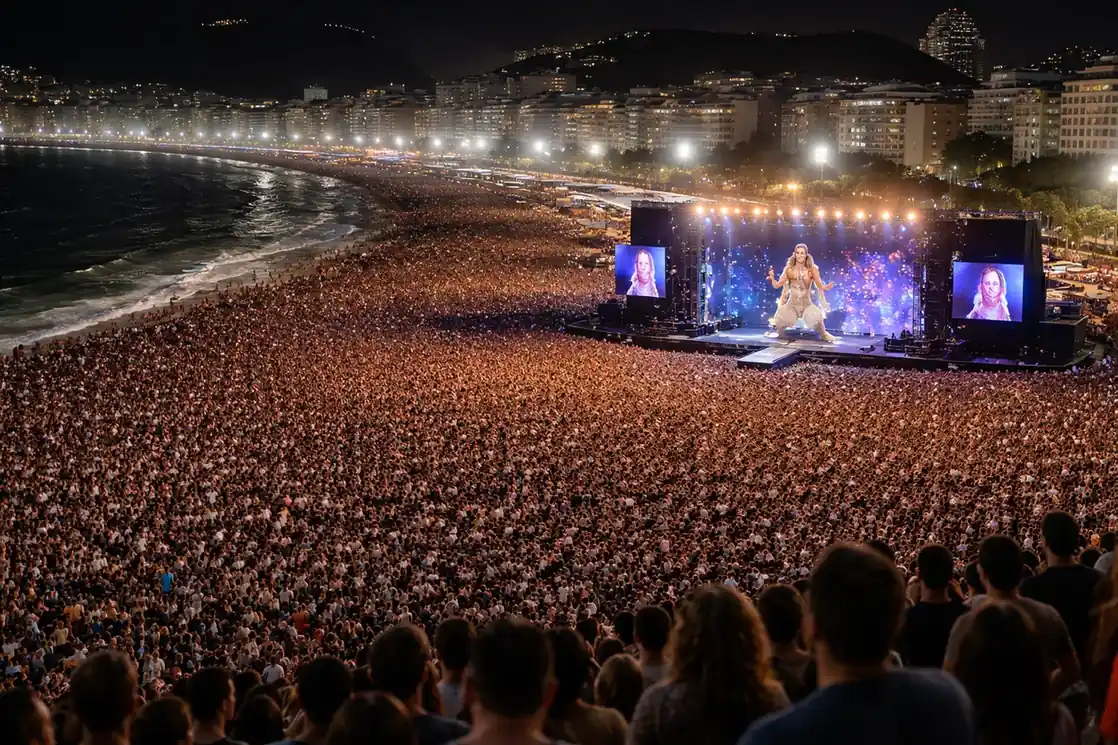
- Shakira performed the 'Todo Mundo no Rio' free concert on Copacabana beach on Saturday night.
- Rio de Janeiro Mayor Eduardo Cavaliere estimated the crowd size at approximately two million people.
- The event is projected to generate R$800 million (approximately £118 million) for the Brazilian economy.
What happened
Shakira drew an enormous crowd to Copacabana beach in Rio de Janeiro for a free public concert that city officials say could deliver a major economic boost as well as a huge cultural spectacle. The event, branded as part of Rio's effort to use large-scale live entertainment to energize tourism and business, turned one of the world's most famous urban beaches into a giant open-air arena. For fans, it was a rare chance to see one of Latin pop's biggest stars without a ticket barrier. For city leaders, it was also an investment in image, movement, and spending.
That dual purpose is what makes the concert notable. A free Shakira show on Copacabana is not only a music event. It is also urban strategy. Rio is using celebrity scale, public space, and spectacle to reinforce its status as a global cultural destination.
Why Copacabana matters as a venue
Copacabana beach has long functioned as more than a leisure site. It is one of the few places in the world where a city can stage an event for hundreds of thousands, or even millions, with immediate visual power and international recognizability. When a superstar performs there, the location itself becomes part of the story. The beach offers a ready-made global image of Brazil: open, musical, crowded, festive, and visually dramatic.
That is why a Copacabana concert carries symbolic weight far beyond an ordinary stadium show. It turns a performance into a public statement about the city and its identity.
Shakira's draw and regional significance
Shakira's appeal in Brazil and across Latin America helps explain the scale of interest. She is not simply a successful recording artist. She is a pan-regional figure whose catalog spans generations and languages, and whose concerts often carry strong emotional resonance across national lines. A free Shakira concert in Rio therefore pulls not just local fans, but visitors, tourists, and viewers who see the event as culturally significant in its own right.
That reach makes her an ideal anchor for a city-backed event designed to maximize attention and economic activity.
The economic argument
Officials have projected hundreds of millions of reais in economic benefit from the concert, including spending tied to hotels, transport, food, retail, and tourism spillover. Such projections are always open to scrutiny, especially when crowd estimates are uncertain or inflated. But even if the precise figure is debated, the underlying logic is clear: large free events can drive concentrated urban spending while generating enormous promotional value for the host city.
In this sense, entertainment is being treated as infrastructure, not just leisure. A concert becomes a short-term economic engine and a long-term branding exercise.
Why crowd estimates become part of the politics
The claimed attendance of roughly two million people matters because numbers like that shape the narrative of success. Huge crowd estimates amplify the perceived value of public spending and strengthen the image of the event as a historic triumph. But they also invite skepticism, especially when officials have incentives to maximize the appearance of impact.
That does not erase the scale of the turnout. It simply means that the crowd figure is part of the political performance surrounding the concert as much as the concert itself.
What comes next
City officials and analysts will now look for evidence of how much hotel occupancy, transport use, and tourism spending the event actually generated. If the numbers support the broader strategy, Rio is likely to continue using this model of free mega-concerts as a tool for cultural prestige and economic stimulation.
For now, the huge crowd at Shakira's free Copacabana beach concert shows how a global pop event can operate on several levels at once: as a mass celebration, as city marketing, and as an experiment in entertainment-led economic growth. The concert mattered not only because Shakira performed to a vast audience, but because Rio used the performance to stage itself before the world.
Why it matters
This event demonstrates how major cities are increasingly using high-profile entertainment as a direct tool for economic revitalization and large-scale tourism growth.
Read next
Follow this story through the topic hub, more world coverage, and the latest updates.
Weekly briefing
Get the week's key developments in one concise email.
Get a fast catch-up on the biggest stories, the context behind them, and the links worth your time.
Cadence
Weekly, for a quick catch-up
Coverage
AI, business, world, security, sports
Format
Clear takeaways and useful context
Request the briefing
Leave your email to open a prepared request and get on the list for the weekly briefing.
About the byline
World correspondent
Leila Haddad covers world affairs, diplomacy, and humanitarian crises, with a focus on how fast-moving international developments affect public policy, conflict response, and cross-border institutions.
Sources and methodology