'Miracle' Survival on Everest: Guide Recounts Six Days Without Oxygen
After being presumed dead by his family, Dawa Sherpa was discovered crawling toward Base Camp following a week-long ordeal in the death zone.
Primary source: BBC World News. Full source links, newsroom standards, and correction details are below.
Fast summary
Start here
- Dawa Sherpa survived six days on Everest above 7,500 meters after running out of supplemental oxygen.
- The 57-year-old guide sustained himself by eating chocolate and chewing ice while trapped in a crevasse for over two days.
- An avalanche inadvertently provided Sherpa with a path out of the crevasse, allowing him to descend toward Base Camp.
What happened
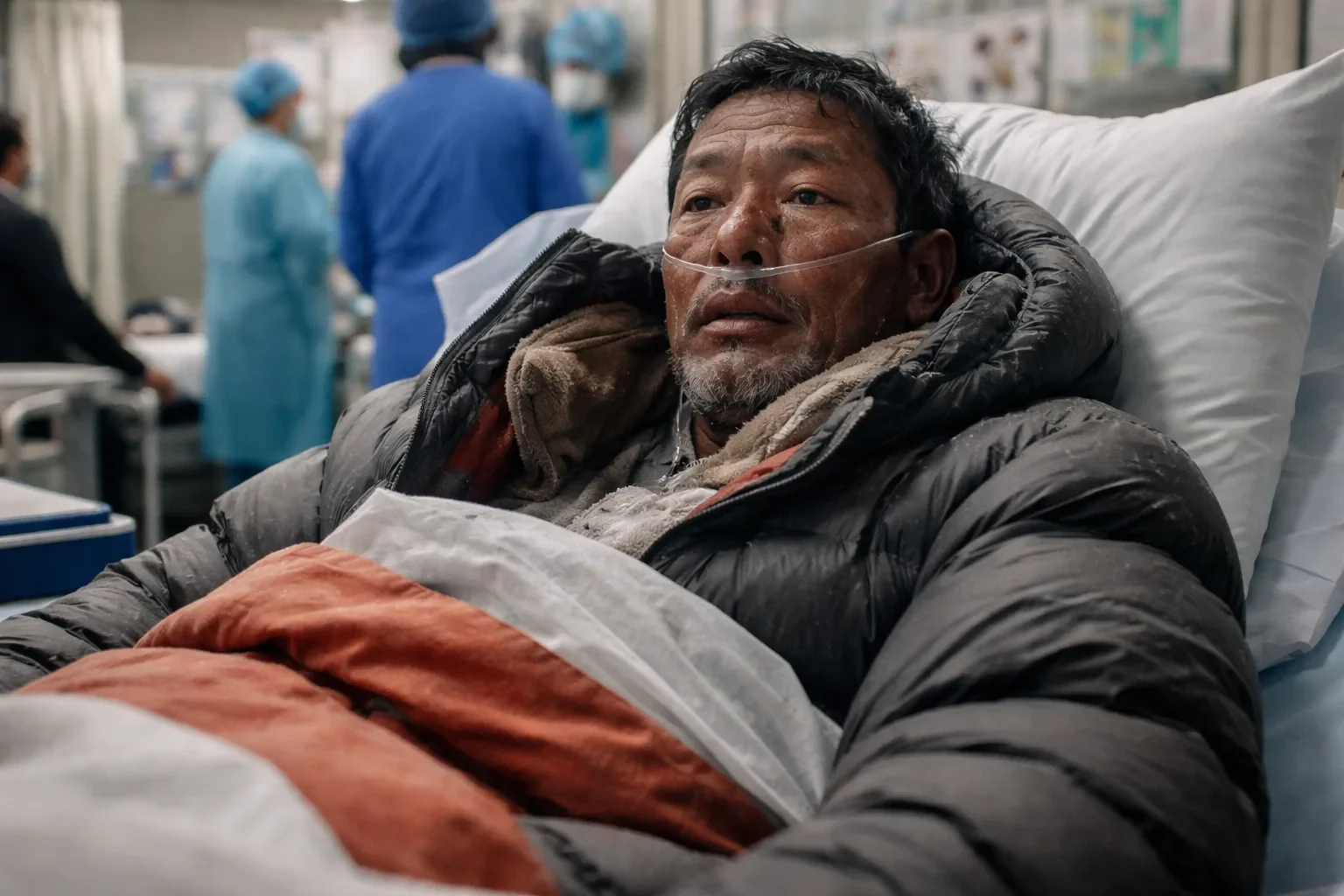
Dawa Sherpa, a seasoned Nepali guide, has been rescued from Mount Everest six days after he was last seen near the Khumbu Icefall. Initially feared dead by his family and the mountaineering community, Sherpa was found 'sliding' toward Base Camp by a pollution clean-up team. He is currently receiving treatment at a hospital in Kathmandu for frostbite, dehydration, and a fractured bone.
What's new in this update
Speaking from his hospital bed, Sherpa clarified that he did not go missing but was forced to stay behind at approximately 7,500 meters when his oxygen supply ran out. He described a harrowing ordeal of chewing hard ice to stay hydrated and finding a few chocolates in his pocket. He also revealed that he spent two-and-a-half days trapped in a crevasse until a subsequent avalanche deposited enough snow for him to climb out.
Key details
British climber Chris Thrall, who was the last to see Sherpa before his disappearance, noted that the guide appeared to be taking a routine rest on his backpack near Camp 3. Thrall's group was assisting a Polish climber suffering from severe frostbite, which drew attention away from Sherpa's situation. Sherpa later navigated his own rescue, using ropes he found after escaping the crevasse and walking through the night to reach the vicinity of Base Camp.
Background and context
This year's Everest climbing season has already seen five confirmed deaths. Since records began in the 1920s, over 300 people have died on the mountain. The Sherpa community and expedition organizers have labeled the event a 'true self-rescue' and a miracle, given that Sherpa's family in Kathmandu had already begun performing funeral rites before news of his survival reached them.
What to watch next
Sherpa remains under medical observation in Kathmandu to address the long-term effects of high-altitude exposure and frostbite. Mountaineering organizations are expected to review the circumstances of the incident, particularly the separation of group members during descents and the protocols for climbers who find themselves without supplemental oxygen in the death zone.
Why this matters
The survival of Dawa Sherpa is considered a rare miracle in high-altitude mountaineering, where oxygen deprivation and extreme cold are typically fatal within hours.
Reader context
This story belongs to Northstar Herald's International Relations coverage, with related entities including Dawa Sherpa, Mount Everest, Nepal, Sherpa. The report is based on BBC World News source material.
Related coverage
Why it matters
The survival of Dawa Sherpa is considered a rare miracle in high-altitude mountaineering, where oxygen deprivation and extreme cold are typically fatal within hours.
Read next
Follow this story through the topic hub, more world coverage, and the latest updates.
Weekly briefing
Get the week's key developments in one concise email.
Get a fast catch-up on the biggest stories, the context behind them, and the links worth your time.
Cadence
Weekly, for a quick catch-up
Coverage
AI, business, world, security, sports
Format
Clear takeaways and useful context
Request the briefing
Leave your email to open a prepared request and get on the list for the weekly briefing.
Author

The world desk follows geopolitics, humanitarian crises, diplomacy, and major international developments with an emphasis on fast updates and public-interest context.
Sources and methodology