Tshisekedi Signals Possible Third Term and 2028 Election Delay in DR
The Congolese president says he will accept a third term if public demand leads to a referendum, while warning that the 2028 polls depend on resolving

World correspondent
Reports on international affairs, diplomacy, and humanitarian developments with an emphasis on official statements, multilateral institutions, and regional context.
Editorial responsibility: Lead reviewer for geopolitics, international institutions, and crisis coverage
Primary source: BBC World News. Full source links and update notes are below.
Fast summary
Start here
- President Tshisekedi stated he would accept a third term if approved by the people through a referendum, despite current two-term limits.
- The 2028 elections may be delayed if conflict involving M23 rebels in the North and South Kivu regions is not resolved.
- Tshisekedi accused Rwanda of stalling peace negotiations to continue profiting from the DRC's mineral resources.
What happened
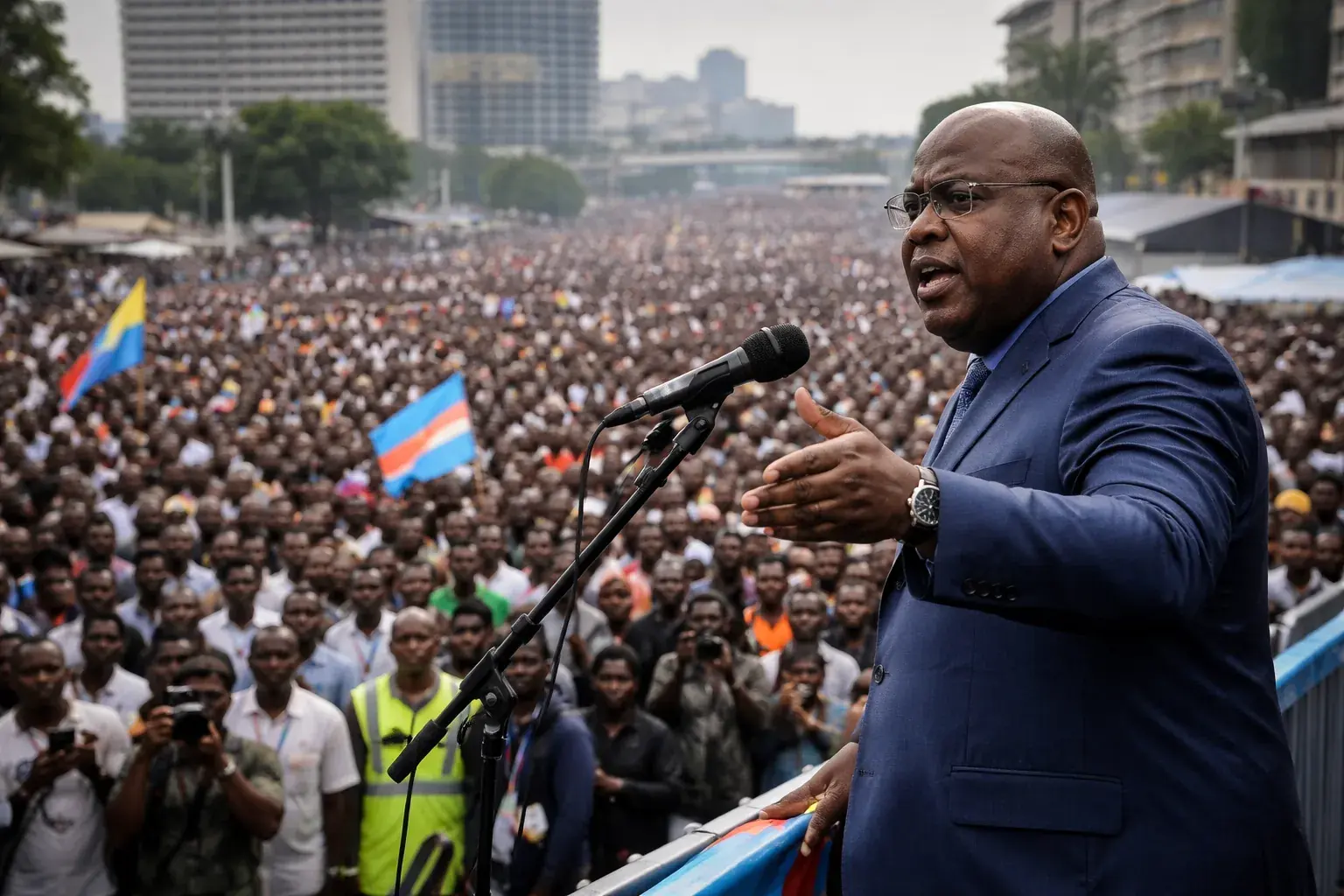
President Félix Tshisekedi has opened the door to seeking a third term and delaying the Democratic Republic of Congo's 2028 elections, tying both possibilities to constitutional change and the unresolved conflict in the country's east. His comments suggest that the electoral calendar and even term-limit rules may no longer be treated as fixed guardrails if security conditions deteriorate further or if a referendum path is used to justify revision. In a country with a long history of contested power, constitutional manipulation, and violent instability, that is an extremely consequential signal.
The basic message is that Tshisekedi is no longer presenting term limits and election timing as immovable commitments. He is presenting them as contingent on politics, war, and public authorization.
What's new in this update
The significant development is not merely that Tshisekedi mentioned a third term. It is that he explicitly linked the issue to a possible referendum and paired it with the suggestion that war in the east could make timely elections impossible. Those two ideas together create a powerful and dangerous political formula: revise the rules if the public can be mobilized to approve it, and suspend the timetable if security conditions remain unstable.
That formula is familiar across parts of the region. Leaders facing constitutional limits often invoke either popular demand or national emergency to extend their tenure. Tshisekedi's remarks therefore carry weight well beyond ordinary campaign positioning. They hint at a potential restructuring of the political order before the 2028 vote even arrives.
Key details
The eastern conflict, especially around M23 activity in North and South Kivu, gives the presidency a real security crisis to point to. But using conflict as a reason to postpone elections also risks creating a precedent in which instability becomes a renewable justification for democratic delay. Opposition figures and civil-society groups are likely to view that possibility as a warning sign rather than a practical contingency plan.
Several dynamics are now converging:
- The constitution currently limits the president to two terms.
- A referendum bill could provide a procedural path to altering the political framework.
- Ongoing conflict with M23 creates a national-security rationale for delay.
- Tshisekedi is framing both issues inside a narrative of national survival and public legitimacy.
This combination makes the issue much larger than a personal ambition story. It is about whether the DRC's democratic institutions can withstand pressure from both war and executive power.
Background and context
The Democratic Republic of Congo has rarely enjoyed smooth democratic transitions. Elections have often been delayed, disputed, or overshadowed by violence and allegations of manipulation. Tshisekedi's presidency already operates within that legacy, and any suggestion of extending mandates naturally triggers concern because many Congolese citizens and observers see institutional fragility as one of the country's defining risks.
The security context is also real. The M23 rebellion and broader regional tensions involving Rwanda have destabilized eastern Congo, displaced civilians, and fueled accusations that external actors benefit from conflict around mineral-rich areas. But acknowledging a crisis is different from allowing that crisis to rewrite constitutional expectations. That is the line critics will watch closely.
What to watch next
The referendum legislation moving through parliament will be one of the most important indicators of intent. If it advances quickly and is framed broadly enough to touch constitutional rules, opposition alarm will intensify. At the same time, developments on the battlefield and in diplomatic talks with Rwanda will shape whether the government can plausibly present election delay as unavoidable rather than opportunistic.
Another key issue is how regional and international actors respond. If external partners stay muted, Tshisekedi may feel he has more room to test constitutional boundaries.
Why this matters
This matters because DR Congo, Félix Tshisekedi, M23, the 2028 election, and the wider health of democracy in Central Africa are now bound together in a high-risk political moment. A third-term push or election delay would not occur in a vacuum. It would take place in a country already strained by conflict, weak institutions, and regional distrust. That is why Tshisekedi's comments are being read not simply as speculation, but as a warning about how power may be negotiated in the years ahead.
Reader context
This story belongs to Northstar Herald's Politics and Democracy coverage, with related entities including DR Congo, Félix Tshisekedi, M23, Central Africa. The report is based on BBC World News source material.
Related coverage
Why it matters
The prospect of extending presidential mandates and delaying elections in the DRC risks political instability and mirrors a broader trend of democratic backsliding in the region.
Read next
Follow this story through the topic hub, more world coverage, and the latest updates.
Weekly briefing
Get the week's key developments in one concise email.
Get a fast catch-up on the biggest stories, the context behind them, and the links worth your time.
Cadence
Weekly, for a quick catch-up
Coverage
AI, business, world, security, sports
Format
Clear takeaways and useful context
Request the briefing
Leave your email to open a prepared request and get on the list for the weekly briefing.
About the byline
World correspondent
Leila Haddad covers world affairs, diplomacy, and humanitarian crises, with a focus on how fast-moving international developments affect public policy, conflict response, and cross-border institutions.
Sources and methodology