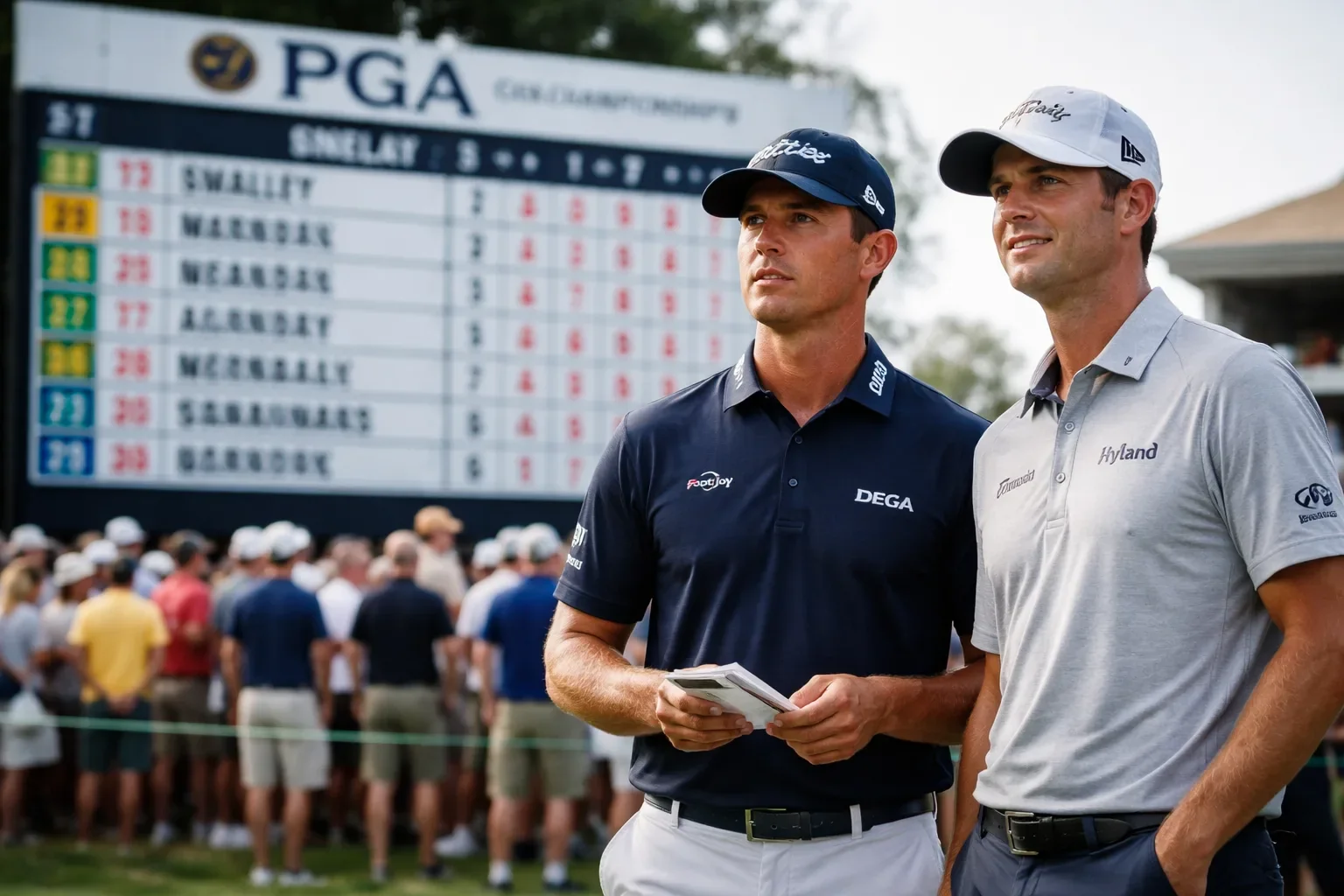
Alex Smalley and Maverick McNealy Lead Crowded PGA Championship
The two golfers sit at the top of the leaderboard, but a significant number of challengers remain within striking distance.

Sports reporter
Reports on leagues, tournaments, and athlete developments with an emphasis on verified event details, official announcements, and commercial context.
Editorial responsibility: Lead reviewer for match reporting, tournament context, and league governance coverage
Primary source: ESPN Top Headlines. Full source links and update notes are below.
Fast summary
Start here
- Alex Smalley and Maverick McNealy are currently tied for the lead.
- The leaderboard is highly competitive with numerous players trailing closely behind the leaders.
- The tournament update indicates a narrow gap between the frontrunners and the chasing pack.
What happened
Alex Smalley and Maverick McNealy moved to the top of a crowded PGA Championship leaderboard, but the bigger story may be how little separation exists between the co-leaders and the rest of the field. In a major tournament, a shared lead matters. In a major tournament with a tightly packed board, it can also be fragile, temporary, and psychologically demanding in ways that a wider cushion would not be.
That is why the Smalley-McNealy PGA leaderboard story is compelling. It is not just about who is first. It is about how many players still believe the championship is within reach.
Why a crowded PGA leaderboard changes everything
When the PGA Championship leaderboard is crowded, strategy and pressure shift. Leaders cannot simply protect a margin because there often is no real margin to protect. Every birdie from the chasing pack changes the emotional atmosphere, and every small mistake by the front-runners can cost multiple spots at once. The tournament becomes less about scoreboard control and more about repeated execution under uncertainty.
That matters especially in a major, where course setup, nerves, and weather can make momentum feel unstable from hole to hole.
What it means for Alex Smalley
For Alex Smalley, leading a PGA Championship leaderboard carries both opportunity and exposure. A major title would instantly change how his career is discussed, but the path from contention to victory is much harder when the board is compressed and every round includes players with more established major-championship experience.
That does not make Smalley an outsider in the moment. It means he has to prove he can keep producing high-level golf while the significance of the occasion keeps increasing.
What it means for Maverick McNealy
Maverick McNealy faces a similar dynamic. Being tied atop the PGA Championship puts him in position, but not in control. In a crowded leaderboard, co-leaders often spend as much time reacting as dictating. The challenge is not simply to stay near par or avoid disaster. It is to remain assertive enough to create birdie chances while resisting the temptation to force shots because the board feels volatile.
This is where majors often become tests of patience as much as shot-making.
Why the chasing pack matters so much
The most dangerous players in a situation like this are not always the ones tied for the lead. They are often the cluster one, two, or three shots back, where the score still feels attackable and the psychology is freer. On a crowded PGA leaderboard, those players can post numbers early, apply pressure, and make the leaders feel as if they are constantly defending ground.
That is why a tied lead in a major can sometimes feel less comfortable than being slightly behind. Leaders carry the position, but the field carries momentum options.
Why majors are different from regular PGA Tour events
A crowded leaderboard on a normal PGA Tour stop can still be tense, but the PGA Championship brings a different level of consequence. A major win changes legacy, ranking, endorsement value, and career identity. For players like Smalley and McNealy, it could redefine how they are perceived permanently.
That added weight affects decision-making. The closer players get to a major title, the more every routine swing begins to feel loaded with career meaning.
What the leaderboard says about the course
A packed board can also reveal something about conditions. It may suggest that the course is yielding enough chances to keep multiple players alive, or that scoring volatility is allowing swings in both directions. Either way, the tournament remains open, which usually makes weekend positioning less stable than fans might expect.
That openness is excellent for viewers and much harder on players. Few things create stress like knowing one missed fairway can move a golfer from tied first to tied tenth.
What comes next
The next rounds will test whether Smalley or McNealy can separate from the crowd or whether the PGA Championship turns into a multi-player sprint where experience, nerve, and short-game sharpness decide everything late. Much will depend on who handles the changing scoreboard best, not just who hits the best isolated shot.
For now, the Smalley-McNealy PGA leaderboard tells us one thing clearly: this major remains open. The co-leaders have earned their positions, but they are surrounded by challengers close enough to turn the championship with a single hot stretch. In a PGA Championship, that makes every hole feel heavier.
Why it matters
The PGA Championship is one of golf's four major tournaments, where a victory significantly impacts world rankings and professional legacy.
Read next
Follow this story through the topic hub, more sports coverage, and the latest updates.
Weekly briefing
Get the week's key developments in one concise email.
Get a fast catch-up on the biggest stories, the context behind them, and the links worth your time.
Cadence
Weekly, for a quick catch-up
Coverage
AI, business, world, security, sports
Format
Clear takeaways and useful context
Request the briefing
Leave your email to open a prepared request and get on the list for the weekly briefing.
About the byline
Sports reporter
Olivia Park covers sports with an emphasis on competition, governance, and the business forces shaping global leagues, major events, and athlete decision-making.
Sources and methodology