Becky Hammon Reaffirms Stance on Jalen Brunson: Prove Me Wrong
The Las Vegas Aces head coach maintains her controversial view that the New York Knicks star does not fit the historical physical profile of a championship

Sports reporter
Reports on leagues, tournaments, and athlete developments with an emphasis on verified event details, official announcements, and commercial context.
Editorial responsibility: Lead reviewer for match reporting, tournament context, and league governance coverage
Primary source: ESPN Top Headlines. Full source links and update notes are below.
Fast summary
Start here
- Becky Hammon stands by her earlier assessment that Jalen Brunson is not a 'Tier 1A' player for a championship team.
- Hammon's critique is based on the historical rarity of small guards winning titles as the primary scoring option.
- The coach expressed a willingness to be proven wrong by the Knicks guard's postseason performance.
What happened
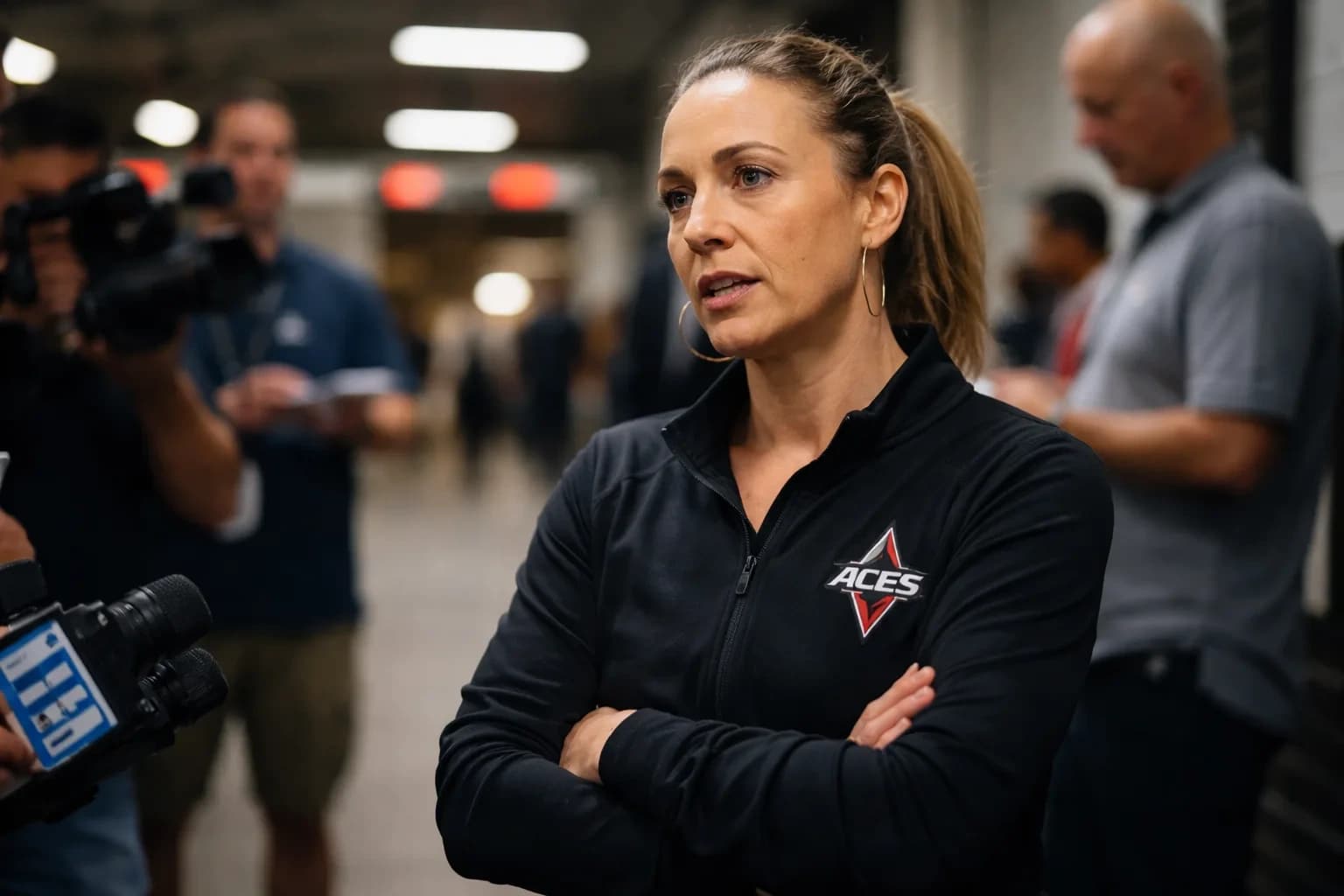
Becky Hammon is standing by her controversial evaluation of Jalen Brunson, saying she still does not view the New York Knicks star as a true "Tier 1A" championship-level lead in the historical mold of players who typically anchor title teams. Hammon's point is not that Brunson lacks skill, production, or toughness. It is that the NBA's championship history tends to favor a certain physical and tactical archetype, and smaller scoring guards rarely sit at the very top of that list unless they are truly exceptional outliers.
That framing keeps the debate alive because Brunson has already done enough to make dismissive criticism look careless. The argument is no longer about whether he is elite. It is about whether he is elite in the exact way required to be the best player on a championship team.
What's new in this update
Hammon's latest comments clarify that she is not backing away from the structure of her earlier analysis, even as she invites Brunson to prove her wrong. She appears to place him in a near-top tier rather than at the absolute summit, essentially arguing that a player can be phenomenal, All-NBA level, and still not fit the archetype most commonly associated with title leadership.
That nuance matters because sports-media backlash often flattens all evaluation into praise or disrespect. Hammon is making a narrower claim rooted in precedent: that undersized primary guards have historically faced harder paths to carrying teams all the way to the Larry O'Brien Trophy.
Key details
The debate sits at the intersection of performance, projection, and historical pattern recognition. Brunson has been the offensive engine for the Knicks, and his postseason scoring, control, and late-game shot creation have strengthened his case as one of the league's defining guards. But Hammon points to size, defensive limitations, and the rarity of this archetype leading a champion as reasons for hesitation.
Several factors shape the argument:
- Brunson is an elite offensive guard and the face of the Knicks.
- Hammon distinguishes between star-level excellence and unquestioned title-leading profile.
- NBA history contains relatively few small-guard championship alpha examples.
- The Knicks' playoff progress becomes real-time evidence in the debate.
This is why the issue resonates beyond one television segment. It taps into how analysts judge greatness in a league where the best regular-season creators do not always map cleanly onto the players who close championship loops.
Background and context
Hammon's comments became a flashpoint partly because Knicks fans see Brunson as the clearest symbol of the franchise's revival. He is not merely productive. He is central to New York's identity, postseason hopes, and roster design. Calling him something less than top-shelf inevitably sounds to supporters like a refusal to acknowledge what has already been proven.
But the counterargument has real history behind it. Many recent title teams have been led by large wings, dominant bigs, or uniquely scalable superstars such as Nikola Jokic, Giannis Antetokounmpo, LeBron James, and others whose size allows broader control over offense and defense. Small guards can dominate stretches, but doing so over four playoff rounds while surviving matchup targeting remains a harder template.
What to watch next
The simplest answer to Hammon's critique is postseason evidence. If Brunson leads the Knicks deep enough, especially against elite defenses, the historical case against his archetype weakens. If New York falls short in ways that expose size, shot-creation burden, or defensive pressure points, Hammon's view gains credibility.
The roster around him also matters. If the Knicks need another co-equal star to break through, observers may interpret that as proof he is more "Tier 1B" than "Tier 1A," to use the language around the debate.
Why this matters
This matters because Becky Hammon, Jalen Brunson, the New York Knicks, NBA evaluation, and basketball analytics are all wrapped into a familiar championship question: what kind of star can truly be the best player on a title team? The debate is not really about whether Brunson is great. It is about whether greatness at his size and style scales all the way to the last stage of the NBA postseason. That is why every Knicks playoff game now doubles as evidence in a larger argument about archetype versus production.
Reader context
This story belongs to Northstar Herald's NBA coverage, with related entities including Becky Hammon, Jalen Brunson, New York Knicks, Las Vegas Aces. The report is based on ESPN Top Headlines source material.
Related coverage
Why it matters
The debate highlights a recurring tension in NBA evaluation between individual statistical excellence and the physical archetypes historically required to win a title.
Read next
Follow this story through the topic hub, more sports coverage, and the latest updates.
Weekly briefing
Get the week's key developments in one concise email.
Get a fast catch-up on the biggest stories, the context behind them, and the links worth your time.
Cadence
Weekly, for a quick catch-up
Coverage
AI, business, world, security, sports
Format
Clear takeaways and useful context
Request the briefing
Leave your email to open a prepared request and get on the list for the weekly briefing.
About the byline
Sports reporter
Olivia Park covers sports with an emphasis on competition, governance, and the business forces shaping global leagues, major events, and athlete decision-making.
Sources and methodology