Florida Governor Signs 'Teddy Bridgewater Act' Legalizing High
The new law allows high school athletes to profit from their name, image, and likeness, keeping Florida competitive with other states.

Sports reporter
Reports on leagues, tournaments, and athlete developments with an emphasis on verified event details, official announcements, and commercial context.
Editorial responsibility: Lead reviewer for match reporting, tournament context, and league governance coverage
Primary source: ESPN Top Headlines. Full source links and update notes are below.
Fast summary
Start here
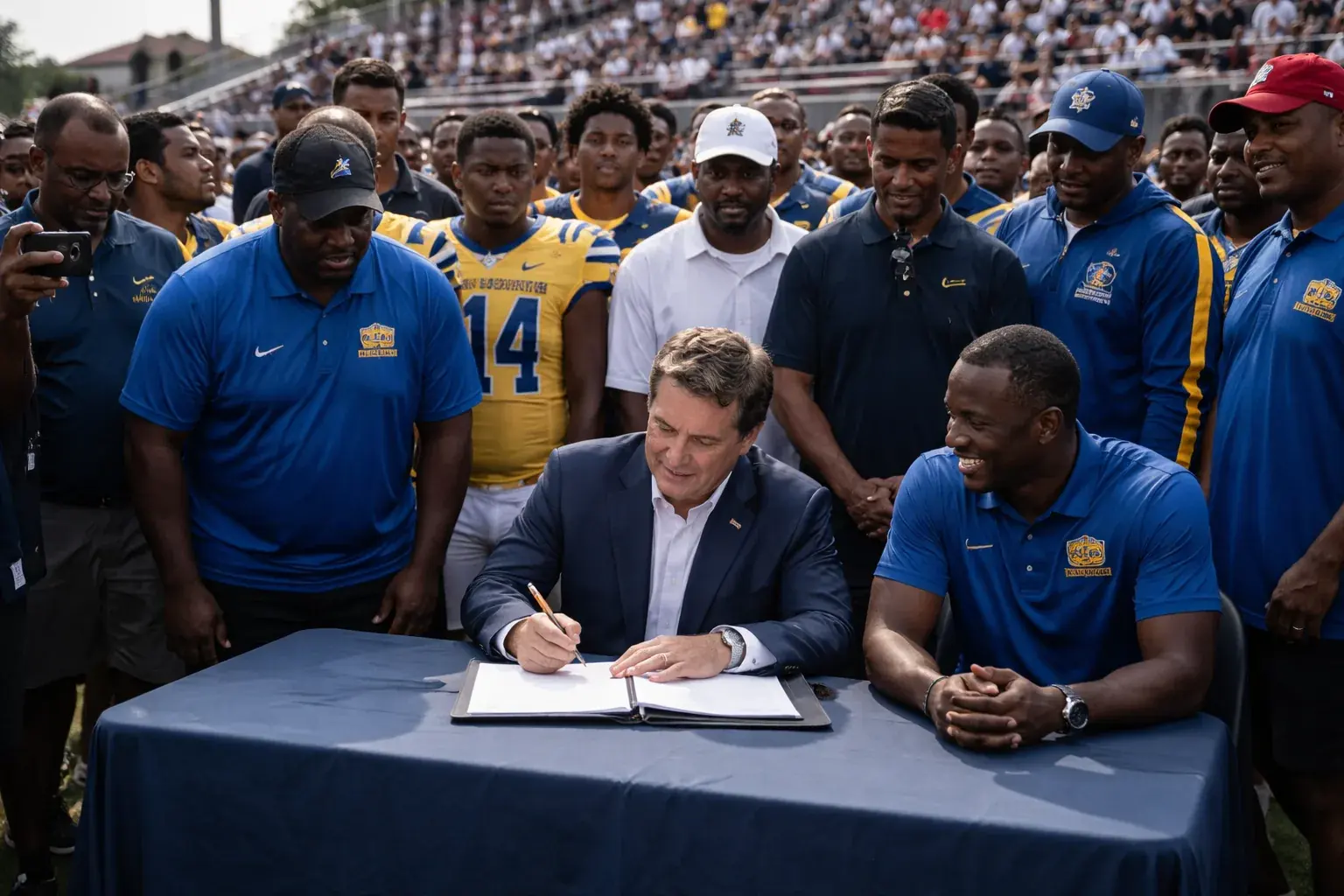
- Governor Ron DeSantis signed the 'Teddy Bridgewater Act' into law, permitting NIL deals for Florida high school athletes.
- The legislation is named after the former NFL quarterback who advocated for the change while coaching at Miami Northwestern.
- The law aims to align Florida's high school athletic policies with the modern collegiate landscape.
What happened
Florida has signed the Teddy Bridgewater Act into law, officially allowing high school athletes in the state to profit from name, image, and likeness. The decision is significant because Florida is one of the most important talent-producing states in American sports, especially football. When a state with that level of recruiting influence changes its NIL rules for high school athletes, the effects reach beyond one legislature or one school association.
That is why the Teddy Bridgewater Act matters. It is not merely a local policy tweak. It changes the competitive and financial environment for prep athletes in a major national talent market.
Why the Teddy Bridgewater Act is a big deal
High school NIL rules are still uneven across the country, which means state policy can affect where elite athletes choose to stay, move, or develop. Florida's decision to allow high school NIL opportunities acknowledges that the old amateur model is already breaking down under the pressure of college-level commercialization, social-media visibility, and recruiting economics.
This matters because Florida did not simply react to a cultural trend. It acted in a way that could materially affect athlete decisions at an earlier stage of the pipeline.
Why Teddy Bridgewater's name matters here
Naming the law after Teddy Bridgewater gives it a specific football and community identity. Bridgewater is not just a former NFL quarterback. He is deeply associated with Florida football culture and with the kind of local credibility that makes a law like this feel connected to athlete experience rather than abstract politics alone.
That matters because NIL debates are often discussed through legal language and market logic. Attaching the law to Bridgewater ties it to player advocacy and developmental fairness in a more human way.
Why Florida felt pressure to change
Florida could not ignore the broader NIL landscape forever. Once other states began allowing high school athletes to monetize their name, image, and likeness, Florida risked falling behind in a competitive environment where families and coaches increasingly compare opportunity structures across state lines. In a major recruiting state, being late can have real consequences.
That is one reason the Teddy Bridgewater Act is best understood not only as permissive legislation, but as defensive legislation. Florida is protecting its position in the national talent market.
What this means for high school athletes
For high school athletes, the law creates real opportunity but also real complexity. NIL can help top players benefit from the value they already generate, especially in football, basketball, and other high-visibility sports. At the same time, it introduces new pressure around representation, deal structure, tax implications, and the uneven distribution of opportunity between stars and everyone else.
That matters because legalization alone does not make the system simple. It simply makes the market official.
The recruiting implications
Recruiting in Florida may now become even more intertwined with branding, local sponsorship relationships, and early commercial positioning. Schools, coaches, collectives, and families will all have to adjust to the reality that athletes can carry market value before they ever sign a college letter of intent.
This could deepen the power of established football regions, but it could also create new pressure on schools and governing bodies to draw lines around inducements, transparency, and third-party influence.
Why implementation will matter
As with most NIL legislation, the real story begins after the signing ceremony. The Florida High School Athletic Association and related bodies will need to translate the new law into actual rules on disclosure, agent involvement, school participation, and conflicts of interest. Poor implementation could create confusion or exploitation. Good implementation could make Florida a model other states watch closely.
That is why the Teddy Bridgewater Act should not be judged only by its headline. Its practical success will depend on governance.
What comes next
The next major questions are how quickly Florida schools and families adapt, what guardrails are put in place, and whether the law intensifies competition for top prep talent within and beyond the state. It will also be worth watching whether other states that have been slower to act feel new pressure to modernize.
For now, Florida signing the Teddy Bridgewater Act into law is a clear turning point in the evolution of high school NIL. In one of the nation's richest recruiting environments, athletes now have a formal path to profit from their visibility much earlier than before, and the ripple effects will be national.
Why it matters
This legislation fundamentally changes the financial landscape for prep athletes in one of the country's most significant recruiting hubs.
Read next
Follow this story through the topic hub, more sports coverage, and the latest updates.
Weekly briefing
Get the week's key developments in one concise email.
Get a fast catch-up on the biggest stories, the context behind them, and the links worth your time.
Cadence
Weekly, for a quick catch-up
Coverage
AI, business, world, security, sports
Format
Clear takeaways and useful context
Request the briefing
Leave your email to open a prepared request and get on the list for the weekly briefing.
About the byline
Sports reporter
Olivia Park covers sports with an emphasis on competition, governance, and the business forces shaping global leagues, major events, and athlete decision-making.
Sources and methodology