Oilers Fire Head Coach Kris Knoblauch After Two Stanley Cup Finals
The dismissal follows a recent slide in the regular season despite Knoblauch's history of leading the franchise to back-to-back championship series.

Sports reporter
Reports on leagues, tournaments, and athlete developments with an emphasis on verified event details, official announcements, and commercial context.
Editorial responsibility: Lead reviewer for match reporting, tournament context, and league governance coverage
Primary source: ESPN Top Headlines. Full source links and update notes are below.
Fast summary
Start here
- Head coach Kris Knoblauch was fired by the Edmonton Oilers on Friday.
- The move comes after Knoblauch led the Oilers to two straight Stanley Cup Finals appearances.
- The organization is seeking a turnaround following recent regular-season underperformance.
What happened
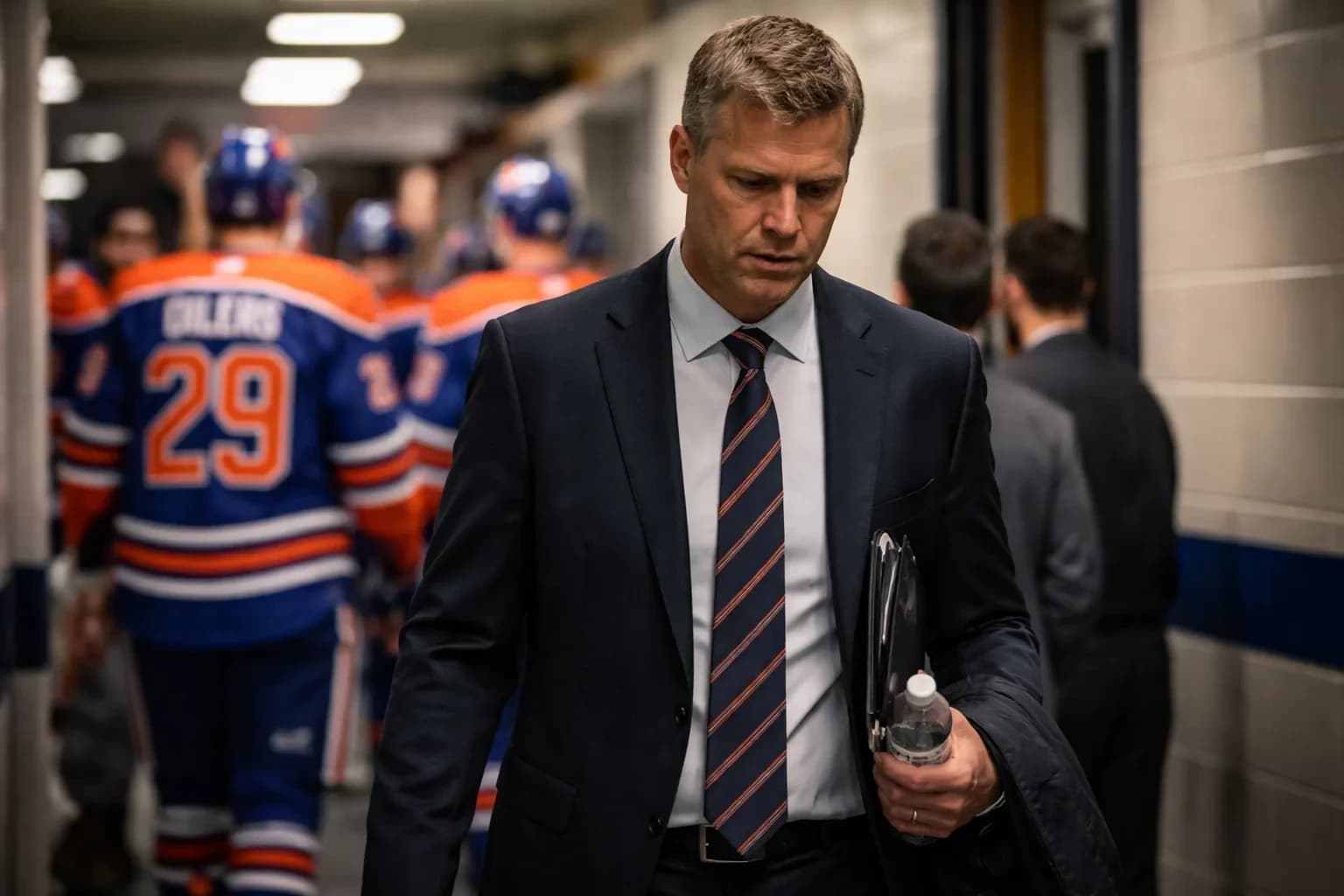
The Edmonton Oilers have fired head coach Kris Knoblauch despite his role in leading the team to back-to-back Stanley Cup Finals, ending one of the more striking recent coaching tenures in hockey. The move is significant because it shows how little insulation postseason credibility provides when a franchise believes its current season is drifting off the championship path.
That is why the Oilers' decision matters. It is not just another coaching change. It is a declaration that Edmonton sees the present as too urgent to protect even a recently successful head coach from accountability.
Why firing Kris Knoblauch is so surprising
On paper, coaches who reach consecutive Stanley Cup Finals are not the obvious candidates for dismissal. That resume usually buys time, trust, and patience. Knoblauch's firing therefore stands out because it signals that the Oilers are evaluating him less on historical credit and more on whether the current group still looks capable of maximizing a championship window in real time.
That kind of decision only happens when a front office believes the slope of the season is more dangerous than the résumé of the coach is protective.
The Connor McDavid and Leon Draisaitl window
Everything about Edmonton's urgency flows through its superstar core. When a team has Connor McDavid and Leon Draisaitl in their primes, every season is measured against a brutal standard: is this group moving closer to a Stanley Cup, or wasting irreplaceable years? That pressure changes how coaching decisions are made.
This is what makes the Oilers such a high-intensity organization. Strong is not enough. Contender is not enough. The expectation is conversion.
Why regular-season slippage matters so much
The NHL postseason can be chaotic, but contenders still have to arrive there in a stable enough condition to make the path credible. If the Oilers showed signs of structural drift in the regular season, especially around defense, goaltending trust, or nightly consistency, management may have concluded that waiting for playoff correction was too risky.
That matters because championship teams are rarely built on the assumption that deep flaws will fix themselves under greater pressure.
Why deep playoff runs do not guarantee security
One of the hardest truths in elite sports is that past success can remain real while still not being enough to secure the present. Knoblauch's finals appearances will remain part of his record, but they do not automatically answer whether the voice, systems, or chemistry around the team had started to plateau. Front offices often act when they fear a message has lost edge even if the coach has not lost ability.
That is likely part of the logic here. The Oilers may not be rejecting Knoblauch's past. They may be reacting to their fear of the near future.
What this says about Edmonton's standards
The firing also reveals how absolute the Oilers' standards have become. This is a team no longer trying to become relevant or respectable. It is trying to become the last team standing. When that is the internal benchmark, coaching changes can come faster and feel harsher than they would elsewhere.
That is why even a resume with two finals appearances was not enough. The organization appears to believe that the margin for complacency is zero.
The risk of making the move
Of course, firing a coach with recent high-end success carries real risk. A change can reset urgency, but it can also create instability, especially if the deeper problems are roster-based rather than voice-based. If the Oilers do not improve meaningfully after this decision, the scrutiny will move quickly from the bench to the executives who made it.
This is what makes the move bold rather than automatically smart. It is easy to make a change. It is harder to prove the change addressed the right problem.
What comes next
The next question is who takes over and what specific improvement the Oilers believe a new voice can unlock. Defensive cohesion, goaltending confidence, special-teams sharpness, and playoff readiness will all be watched through that lens.
For now, the Oilers firing Kris Knoblauch is one of the clearest signs in hockey that recent success is not enough when a franchise feels the Stanley Cup window tightening. Edmonton has chosen urgency over continuity. The burden is now on the organization to prove that choice brings them closer to the title they believe they should already be chasing at full speed.
Why it matters
The Oilers are operating in a strict championship-or-bust window, and the firing demonstrates that even deep postseason runs do not guarantee job security during a regular-season decline.
Read next
Follow this story through the topic hub, more sports coverage, and the latest updates.
Weekly briefing
Get the week's key developments in one concise email.
Get a fast catch-up on the biggest stories, the context behind them, and the links worth your time.
Cadence
Weekly, for a quick catch-up
Coverage
AI, business, world, security, sports
Format
Clear takeaways and useful context
Request the briefing
Leave your email to open a prepared request and get on the list for the weekly briefing.
About the byline
Sports reporter
Olivia Park covers sports with an emphasis on competition, governance, and the business forces shaping global leagues, major events, and athlete decision-making.
Sources and methodology