SpaceX Officially Prices Shares at $135 in World's Largest IPO
The space and AI conglomerate raised $75 billion, eclipsing Saudi Aramco's previous record and setting the stage for a Friday debut on the Nasdaq.

AI reporter
Reports on model launches, frontier labs, developer platforms, and AI policy with an emphasis on claims verification and rollout context.
Editorial responsibility: Lead reviewer for AI coverage, launch claims, and policy context
Primary source: TechCrunch AI. Full source links and update notes are below.
Fast summary
Start here
- SpaceX priced 555.6 million shares at $135 each, raising a record-breaking $75 billion for the company and its underwriters.
- The offering makes SpaceX the largest IPO in history, easily surpassing the $24.9 billion raised by Saudi Aramco in 2019.
- At the set price, Elon Musk is poised to become the world's first trillionaire due to his extensive Class A and Class B shareholdings.
What happened
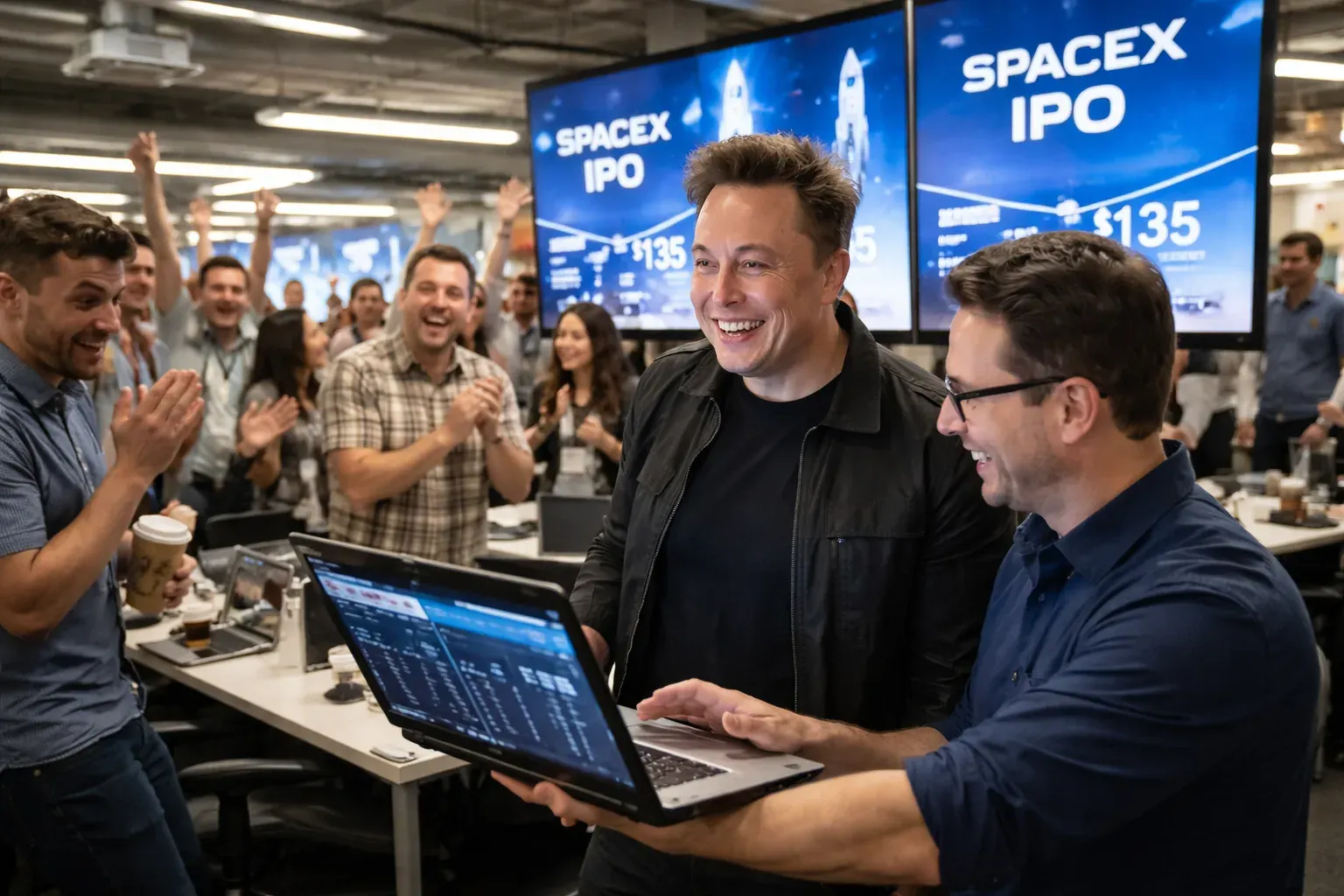
SpaceX has officially priced its long-awaited IPO at $135 per share, raising $75 billion in what is being described as the largest initial public offering ever. The size of the deal immediately places it in a category beyond a normal market debut. This is not simply a successful listing for a high-profile private company. It is a capital-markets event large enough to test investor appetite for one of the most ambitious corporate visions in the world.
The company is expected to trade on the Nasdaq under the symbol SPCX, and the scale of demand suggests that investors are buying not only current business performance, but also a very long-range story about launch infrastructure, space communications, advanced manufacturing, and AI-linked industrial capacity.
Why this IPO is such a landmark
The SpaceX IPO pricing matters because it breaks prior records and resets expectations for how public markets may value technology companies with both real revenue and extraordinary strategic narratives. Raising $75 billion in a single offering dwarfs the deal sizes most modern listings can even attempt.
That scale matters for several reasons:
- It gives SpaceX massive new financial flexibility.
- It creates enormous liquidity for early investors and insiders.
- It turns one of the most watched private firms into a public-market benchmark.
- It tests whether markets will reward infrastructure-heavy ambition at an unprecedented level.
This is a deal investors will compare against not just other IPOs, but against entire eras of tech financing.
Why investors are still willing to pay up
The company benefits from a rare combination of strengths: a globally recognized brand, visible technical achievement, repeated private-market enthusiasm, and a founder whose projects are treated by many investors as category-defining even when they are risky. The fact that the offering was reportedly heavily oversubscribed suggests the market sees SpaceX as more than a launch company.
In the public imagination and increasingly in capital markets, SpaceX is being valued as a multi-layered infrastructure platform touching launch, communications, logistics, defense, AI-adjacent compute, and long-horizon industrial projects. That broad narrative helps explain why the deal could support such aggressive scale.
Elon Musk's shadow over the offering
The Elon Musk SpaceX IPO angle is unavoidable. Musk's enormous shareholdings mean the offering does not only change SpaceX's capital structure. It also pushes his personal wealth into territory that carries symbolic and political weight of its own. Investors are not simply buying exposure to SpaceX's operations. They are buying into a corporate ecosystem closely tied to one of the most polarizing and influential figures in technology.
That cuts both ways. Musk brings attention, ambition, and the ability to attract capital around extreme goals. He also brings execution risk, political volatility, and expectations that can become difficult to satisfy once a company is subject to the quarter-by-quarter discipline of public markets.
Why public-market life changes the story
A record-setting listing can create momentum, but it also changes the company's obligations. Public investors will eventually want more visibility into how SpaceX balances long-horizon projects against nearer-term commercial performance. That matters because many of the company's most exciting ambitions, including those linked to Mars and expanded industrial integration, are expensive, uncertain, and difficult to value conventionally.
The move to public markets therefore creates a tension: how does a company built around extreme engineering goals preserve its long-term narrative while satisfying the reporting expectations of public shareholders?
What to watch next
The first thing to watch is post-listing trading. Strong opening demand would reinforce the idea that investors were willing to pay even more than the IPO price suggested. After that, the focus will shift quickly to disclosures, capital deployment, and whether SpaceX uses its new balance-sheet strength to accelerate projects tied to manufacturing, AI-linked infrastructure, and space systems.
Why this matters
The SpaceX sets record with $75 billion IPO pricing at $135 per share story matters because it marks a turning point in both capital markets and technology symbolism. A company built around rockets, infrastructure, and civilization-scale ambition has now been priced by public investors at a historic level. The offering is a financial event, but it is also a referendum on how much the market is willing to fund the future in advance.
Related coverage
Why it matters
This IPO represents a massive shift in capital markets, moving a generation-defining technology leader to public status while testing investor appetite for multi-planetary infrastructure.
Read next
Follow this story through the topic hub, more ai coverage, and the latest updates.
Weekly briefing
Get the week's key developments in one concise email.
Get a fast catch-up on the biggest stories, the context behind them, and the links worth your time.
Cadence
Weekly, for a quick catch-up
Coverage
AI, business, world, security, sports
Format
Clear takeaways and useful context
Request the briefing
Leave your email to open a prepared request and get on the list for the weekly briefing.
About the byline
AI reporter
Alex Rivera reports on artificial intelligence with an emphasis on model launches, frontier lab strategy, developer tooling, and the policy decisions shaping commercial deployment.
Sources and methodology