Bezos-Backed Prometheus Raises $12B to Build ‘Artificial General
The startup aims to automate the design and manufacturing of complex physical systems including jet engines and pharmaceuticals.

AI reporter
Reports on model launches, frontier labs, developer platforms, and AI policy with an emphasis on claims verification and rollout context.
Editorial responsibility: Lead reviewer for AI coverage, launch claims, and policy context
Primary source: TechCrunch AI. Full source links and update notes are below.
Fast summary
Start here
- Prometheus raised $12 billion at a $41 billion valuation, backed by Bezos, JPMorgan Chase, and BlackRock.
- The startup is developing an "artificial general engineer" to automate complex physical system design and manufacturing.
- Co-founder Jeff Bezos argues that AI productivity will create "labor scarcity" rather than permanent mass unemployment.
What happened
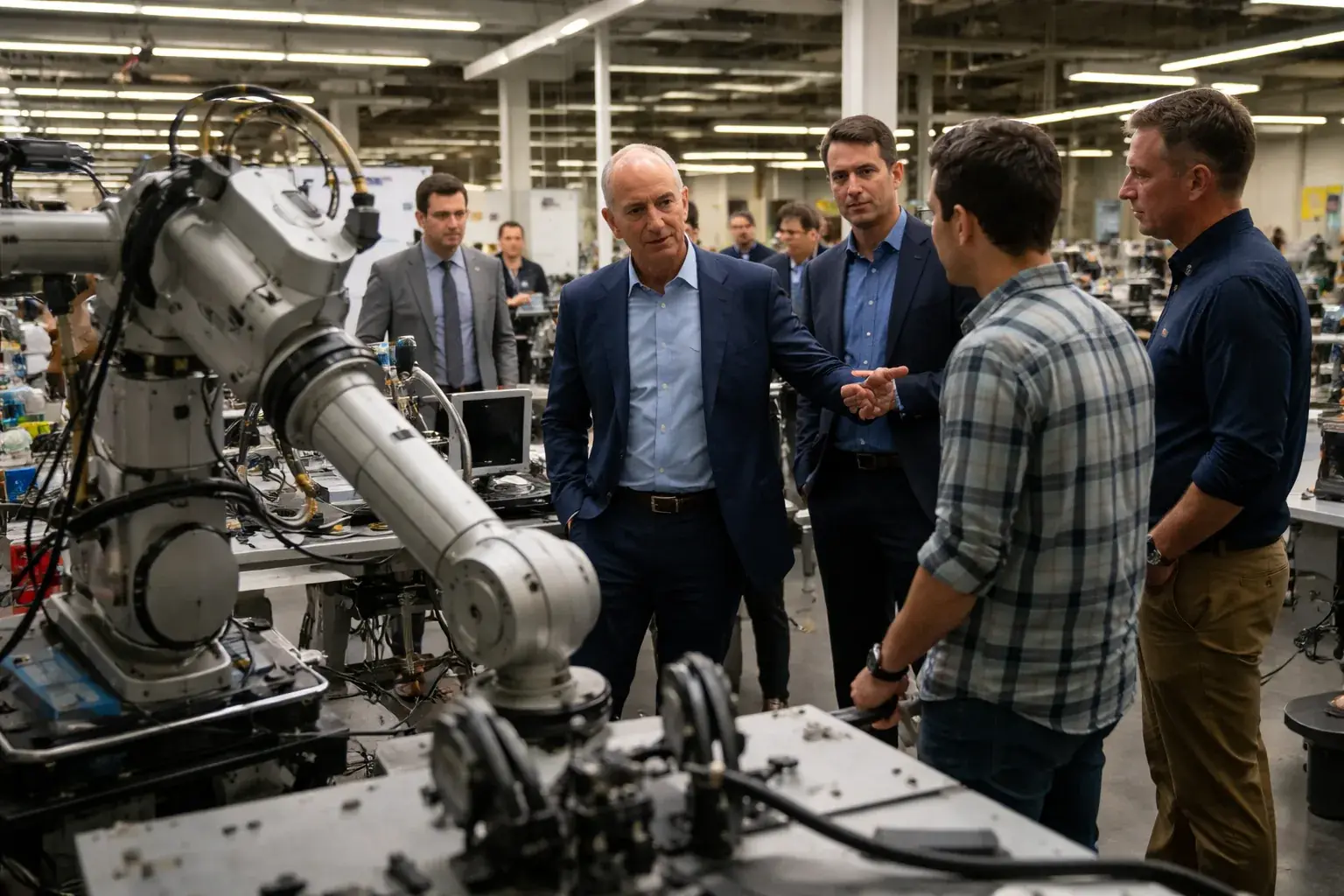
Prometheus, the physical AI startup co-founded by Jeff Bezos and Vik Bajaj, has raised $12 billion in new financing at a reported $41 billion valuation. The size of the deal immediately places Prometheus among the most heavily funded artificial intelligence companies in the market and signals that investors are willing to spend aggressively on AI systems aimed at the physical economy, not just software productivity. Backers in the round include Bezos as well as large financial institutions such as JPMorgan Chase, Goldman Sachs, and BlackRock.
What's new in this update
This latest financing comes after an earlier $6.2 billion raise, meaning Prometheus has accumulated a war chest on a scale normally associated with mature infrastructure companies rather than young startups. Bezos has indicated that a large share of the money will go toward compute, an important detail because it suggests Prometheus expects model training, simulation, and deployment costs to remain extremely high. The company has not yet disclosed much about commercial traction or benchmark results, but the funding itself shows investors believe physical AI could become one of the next decisive categories in the industry.
Key details
Prometheus employs around 150 people across San Francisco, London, and Zurich. Its central goal is to build what it describes as an "artificial general engineer," a system designed to automate significant portions of engineering work for complex physical systems. That includes problems such as jet engine design, industrial optimization, and even pharmaceutical or chemical development, where software has to deal with manufacturing constraints, materials behavior, and safety requirements rather than just text prediction.
That ambition separates Prometheus from the consumer AI wave. A chatbot can be useful while still making occasional mistakes. An AI system involved in physical engineering, by contrast, has to operate under far tighter tolerances. Errors can lead to design failures, production delays, compliance issues, and major financial losses. That is why the company's promise carries both huge upside and unusually high technical risk.
Background and context
The idea behind physical AI is that the next major economic payoff from artificial intelligence may come from industries that build things in the real world. Factories, aerospace companies, chemical manufacturers, and advanced research labs all rely on engineering processes that are expensive, slow, and heavily constrained. If AI can reduce design cycles, improve simulation accuracy, or automate more of the trial-and-error stage, the value created could exceed what many consumer subscription products deliver.
Bezos is an especially influential figure in that narrative. Through Amazon, he helped build businesses defined by logistics, cloud infrastructure, automation, and massive operational scale. His involvement gives Prometheus credibility with investors looking for a founder-backed bet on industrial transformation. Bajaj's role matters too because the company is trying to combine scientific rigor with startup speed, not simply repackage a general-purpose model for enterprise customers.
The round also highlights a broader capital rotation inside AI. As generative AI software becomes crowded, some investors are looking for businesses with deeper moats tied to data, compute, manufacturing integration, and domain-specific execution. Prometheus fits that thesis because physical engineering is difficult to fake and hard to commoditize if the underlying system truly works.
What to watch next
The next milestone for Prometheus is proof of capability. Investors and industry partners will want evidence that the company's artificial general engineer can meaningfully reduce development time, improve design quality, or lower manufacturing costs in real production environments. Vision alone will not justify a $41 billion valuation for long.
Observers will also watch how Prometheus integrates with established engineering software, simulation workflows, and industrial supply chains. If customers have to rebuild their entire process to use it, adoption could slow. If the company can slot into existing systems and deliver measurable gains, it could become one of the defining names in AI infrastructure and robotics-adjacent software. If not, this funding round will be remembered as one of the largest and riskiest bets yet on the future of physical AI.
Why it matters
This represents one of the largest single bets on the physical AI sector, signaling a shift in investment toward automating heavy industry and hardware design.
Read next
Follow this story through the topic hub, more ai coverage, and the latest updates.
Weekly briefing
Get the week's key developments in one concise email.
Get a fast catch-up on the biggest stories, the context behind them, and the links worth your time.
Cadence
Weekly, for a quick catch-up
Coverage
AI, business, world, security, sports
Format
Clear takeaways and useful context
Request the briefing
Leave your email to open a prepared request and get on the list for the weekly briefing.
About the byline
AI reporter
Alex Rivera reports on artificial intelligence with an emphasis on model launches, frontier lab strategy, developer tooling, and the policy decisions shaping commercial deployment.
Sources and methodology