Snowflake and AWS Reach $6 Billion Agreement for AI Infrastructure
The five-year deal focuses on Amazon's custom Graviton CPUs to power Snowflake’s Cortex AI and automated agents.

AI reporter
Reports on model launches, frontier labs, developer platforms, and AI policy with an emphasis on claims verification and rollout context.
Editorial responsibility: Lead reviewer for AI coverage, launch claims, and policy context
Primary source: TechCrunch AI. Full source links and update notes are below.
Fast summary
Start here
- Snowflake committed $6 billion over five years to AWS, nearly matching its total historical spending with the provider since 2012.
- The agreement emphasizes access to AWS's ARM-based Graviton CPUs, which are optimized for AI inference and automated agents.
- Snowflake’s customers doubled their spending on AWS-based services to $2 billion in 2025, driven by demand for generative AI tools.
What happened
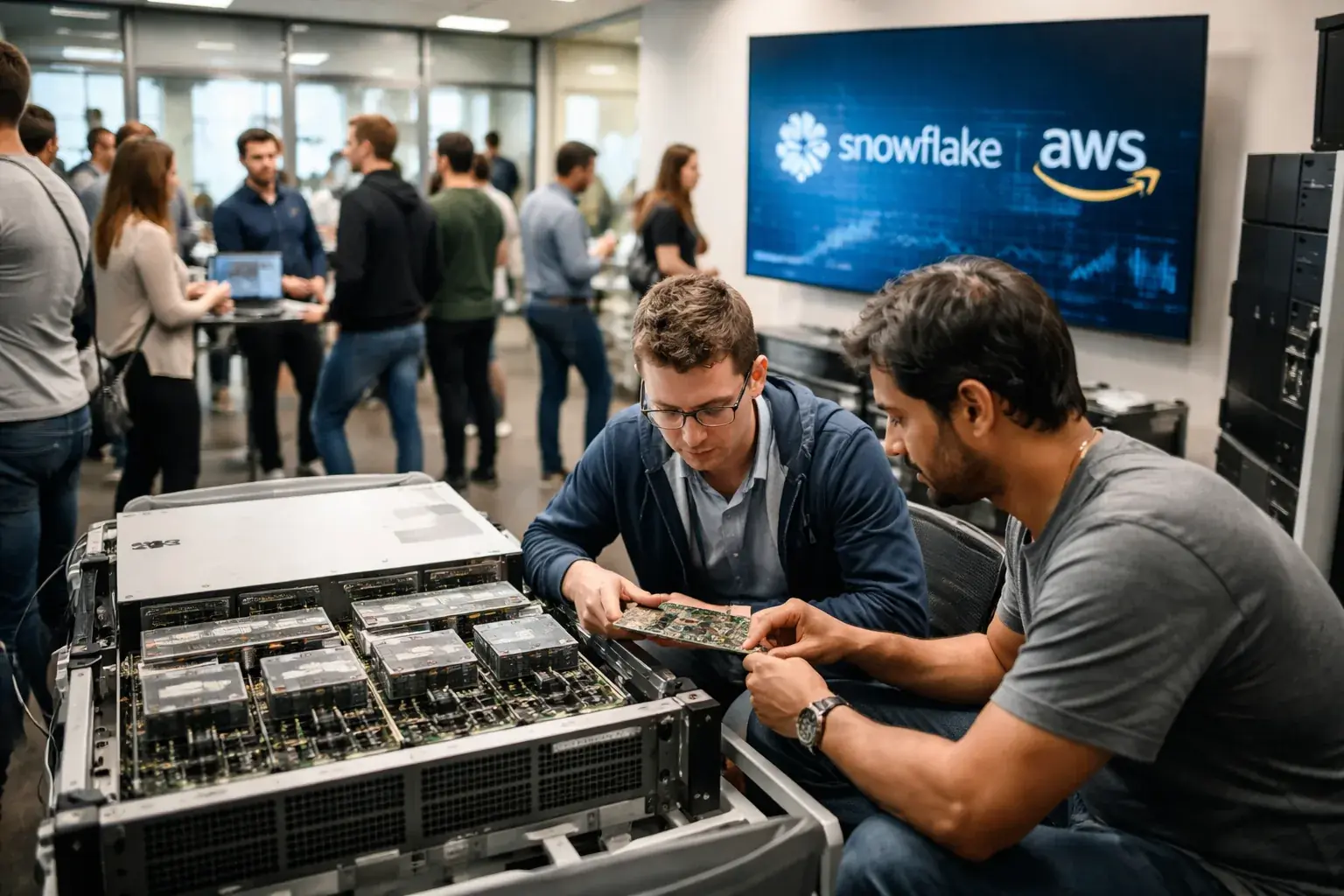
Snowflake has signed a five-year, $6 billion deal with Amazon Web Services that places custom Graviton CPUs at the center of its next phase of AI infrastructure growth. The agreement is striking not only because of its size, but because of what it says about where enterprise AI spending is moving. Rather than focusing only on giant GPU clusters for training frontier models, Snowflake is betting heavily on the infrastructure needed for inference, data workloads, and AI agents that must run constantly and economically in production environments.
That distinction matters because the economics of AI are changing. Training remains prestigious and expensive, but the day-to-day cost of serving models, automating workflows, and scaling enterprise AI products may increasingly depend on the price-performance of non-GPU compute.
What's new in this update
The most important detail is the emphasis on AWS Graviton chips. These ARM-based CPUs are not merely generic cloud resources in this context. They are being positioned as a strategic alternative for workloads where Nvidia-class GPU dominance is not the only answer. Snowflake's Cortex AI and agent-driven services require scalable inference and repeated operational execution, and AWS wants Graviton to be the architecture that makes those workloads cheaper and more defensible over time.
The size of the deal also signals Snowflake's confidence that enterprise customers will keep expanding AI usage on top of its platform. If customer demand for generative AI, automation, and data-centric AI products were not expected to rise substantially, a five-year $6 billion commitment would be much harder to justify.
Key details
Snowflake has long been one of the strongest data-platform companies in the cloud era, and its strategic importance grows when enterprises want AI systems that can sit close to governed data rather than operate as isolated chat tools. This AWS agreement appears designed to ensure that Snowflake can serve that role at scale without relying exclusively on the highest-cost chip tiers.
Several themes emerge from the partnership:
- Snowflake is nearly matching its entire prior historical AWS spend with one forward commitment.
- AWS is using Graviton as a flagship answer to the inference and agent-compute economy.
- Enterprises are spending more inside Snowflake as generative AI products move toward production.
- The AI chip market is broadening beyond the headline race around Nvidia training hardware.
This is why the deal has strategic significance for both companies. Snowflake gets a large-scale infrastructure path for AI growth, and AWS gets a major proof point that custom silicon can win serious enterprise commitments.
Background and context
The AI infrastructure market is entering a phase where training and inference are being distinguished more sharply. Nvidia remains dominant in the training narrative, but cloud providers increasingly want customers to believe that the long-term revenue pool lies in repeated, everyday AI execution across business workflows. That is where CPUs, custom accelerators, and vertically integrated cloud economics start to matter much more.
Snowflake's role is especially interesting because it sits between data warehousing, application logic, and enterprise AI services. If companies want AI features embedded in data products and governed business systems, Snowflake is well placed to capture that demand. The AWS partnership suggests that both firms see that opportunity as large enough to justify unusually deep infrastructure alignment.
What to watch next
The next thing to watch is whether Snowflake's AI products drive enough real customer usage to validate this level of long-term infrastructure commitment. Signed capacity is one thing. Durable monetization from Cortex AI, automated agents, and related services is another. If enterprise adoption stays strong, the agreement could become a template for how cloud and data-platform players co-invest around AI economics.
It will also be worth watching the competitive response. Google, Microsoft, and Nvidia all have reasons to challenge the idea that CPU-centric or custom-cloud-chip strategies can capture the most valuable parts of the AI runtime market.
Why this matters
This matters because Snowflake, AWS, Graviton, cloud computing, AI chips, Cortex AI, and the broader shift toward inference-heavy enterprise AI are all wrapped into the same strategic bet. The $6 billion deal suggests the next major infrastructure prize may not be only who trains the biggest models, but who can run AI cheaply, repeatedly, and at enterprise scale. That is where custom cloud silicon could become a decisive competitive layer.
Reader context
This story belongs to Northstar Herald's Generative AI and AI Infrastructure coverage, with related entities including Snowflake, Amazon Web Services, AWS, Graviton. The report is based on TechCrunch AI source material.
Related coverage
Why it matters
This deal underscores the growing importance of custom-built cloud chips as alternatives to Nvidia GPUs for the inference and automation phase of AI development.
Read next
Follow this story through the topic hub, more ai coverage, and the latest updates.
Weekly briefing
Get the week's key developments in one concise email.
Get a fast catch-up on the biggest stories, the context behind them, and the links worth your time.
Cadence
Weekly, for a quick catch-up
Coverage
AI, business, world, security, sports
Format
Clear takeaways and useful context
Request the briefing
Leave your email to open a prepared request and get on the list for the weekly briefing.
About the byline
AI reporter
Alex Rivera reports on artificial intelligence with an emphasis on model launches, frontier lab strategy, developer tooling, and the policy decisions shaping commercial deployment.
Sources and methodology