SK Hynix Hits Nasdaq with $26.5 Billion Record Foreign IPO
SK Hynix breaks records with a $26.5 billion US offering as commerce officials pressure the Korean memory leader to expand manufacturing on American soil.

AI reporter
Reports on model launches, frontier labs, developer platforms, and AI policy with an emphasis on claims verification and rollout context.
Editorial responsibility: Lead reviewer for AI coverage, launch claims, and policy context
Primary source: TechCrunch AI. Full source links and update notes are below.
Fast summary
Start here
- SK Hynix raised $26.5 billion by selling 177.9 million American depositary shares, surpassing Alibaba’s 2014 record for a foreign company.
- The capital will fund a new fabrication plant and packaging facility in South Korea along with advanced EUV lithography equipment.
- U.S. Commerce Secretary Howard Lutnick is actively lobbying the firm to establish new production facilities within the United States.
What happened
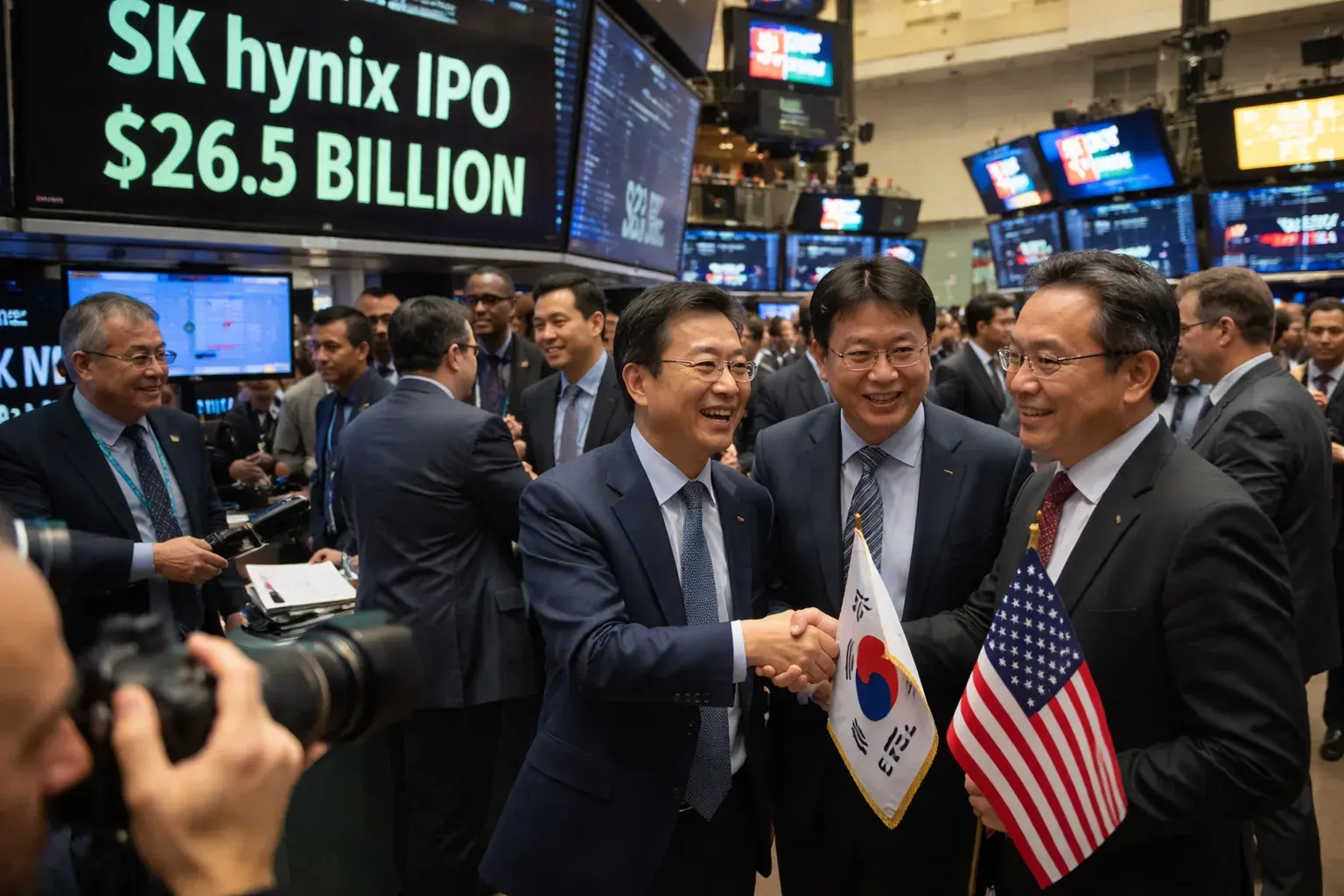
SK Hynix officially entered the U.S. public markets on Friday, raising a staggering $26.5 billion in what has become the largest-ever initial public offering by a foreign entity on Wall Street. The South Korean memory specialist sold 177.9 million American depositary shares priced at $149 each. This valuation allowed the company to comfortably surpass the previous record set by Alibaba’s $25 billion debut in 2014. Trading under the temporary ticker SKHYV on the Nasdaq, the stock saw immediate investor enthusiasm, opening 14% above its IPO price. The successful launch underscores a massive appetite for hardware companies that underpin the generative artificial intelligence sector, as investors look beyond traditional software plays to the physical infrastructure required for large-scale model training and data processing.
What's new in this update
Coinciding with the market debut, U.S. Commerce Secretary Howard Lutnick signaled a new phase of diplomatic and economic pressure on the semiconductor industry. Speaking at a separate event for Micron, Lutnick revealed ongoing discussions with SK Hynix and its rival Samsung regarding the establishment of new fabrication plants on U.S. soil. While SK Hynix currently plans to deploy the bulk of its new $26.5 billion windfall toward domestic projects in South Korea—including a new fabrication plant and an advanced packaging facility—the U.S. government is pushing for a more balanced geographic distribution of chip production. This request aligns with the broader goals of the CHIPS and Science Act, as Washington seeks to reduce reliance on East Asian supply chains for critical AI components like high-bandwidth memory.
Key details
The financial structure of the offering was designed to maximize accessibility for U.S. retail and institutional investors. Each American depositary share was priced at roughly one-tenth of the cost of a full share traded on the Seoul exchange, lowering the barrier to entry for Western capital. Despite pricing the U.S. shares at a 2.7% premium relative to its three-day average on the Korea Stock Exchange, demand for the offering reportedly exceeded the available supply by more than seven times. This surge in interest effectively neutralized the "Korea Discount," a long-standing trend where South Korean firms are undervalued due to corporate governance complexities and regional geopolitical risks. Instead, SK Hynix’s critical role as a Tier 1 supplier for Nvidia’s AI processors has positioned it as a premium asset.
Background and context
The ascent of SK Hynix is tethered closely to the success of Nvidia and the broader AI GPU market. SK Hynix is a dominant provider of High-Bandwidth Memory (HBM), which is essential for the high-speed data transfer required by modern AI accelerators. Unlike traditional DRAM, HBM stacks memory chips vertically to save space and increase efficiency, a technology where SK Hynix currently holds a significant competitive edge over rivals Samsung and Micron. Historically, South Korean tech firms have struggled with lower valuations compared to American peers, but the urgent global need for advanced memory has shifted the narrative. The company’s recent commitment to investing over $550 billion in South Korean manufacturing alongside Samsung highlights the massive scale of the capital expenditures required to stay at the leading edge of the industry.
What to watch next
Investors are now looking toward Monday, July 13, when the company transitions from its temporary ticker to its permanent Nasdaq symbol, SKHY. This move to regular trading will test the stock's long-term stability after the initial IPO hype. Furthermore, the industry will be watching for any official response from SK Hynix regarding Secretary Lutnick’s push for U.S.-based manufacturing. While the company has already earmarked its current IPO proceeds for South Korean facilities and the acquisition of advanced EUV lithography scanners, the potential for U.S. government incentives could pivot future expansion plans. The ongoing rivalry with Micron, which recently committed $250 billion to American manufacturing, will likely force SK Hynix to decide whether its future growth lies in concentrated domestic clusters or a more diversified global footprint.
Why it matters
This IPO marks a shift in global capital flowing into the AI supply chain, prioritizing South Korean hardware expertise while sparking a geopolitical push for domestic US manufacturing.
Read next
Follow this story through the topic hub, more ai coverage, and the latest updates.
Weekly briefing
Get the week's key developments in one concise email.
Get a fast catch-up on the biggest stories, the context behind them, and the links worth your time.
Cadence
Weekly, for a quick catch-up
Coverage
AI, business, world, security, sports
Format
Clear takeaways and useful context
Request the briefing
Leave your email to open a prepared request and get on the list for the weekly briefing.
About the byline
AI reporter
Alex Rivera reports on artificial intelligence with an emphasis on model launches, frontier lab strategy, developer tooling, and the policy decisions shaping commercial deployment.
Sources and methodology