OpenAI Launches GPT-5.6 Model Family Including Sol, Terra and Luna
OpenAI introduces the GPT-5.6 family of models and ChatGPT Work, targeting enterprise efficiency with new cybersecurity and coding capabilities.

AI reporter
Reports on model launches, frontier labs, developer platforms, and AI policy with an emphasis on claims verification and rollout context.
Editorial responsibility: Lead reviewer for AI coverage, launch claims, and policy context
Primary source: TechCrunch AI. Full source links and update notes are below.
Fast summary
Start here
- GPT-5.6 includes three model tiers—Sol, Terra, and Luna—designed for varying performance and cost requirements.
- CEO Sam Altman reports that the flagship Sol model is 54% more token efficient for AI coding tasks than previous iterations.
- The release includes ChatGPT Work, a new cross-platform companion specifically for enterprise document and data management.
What happened
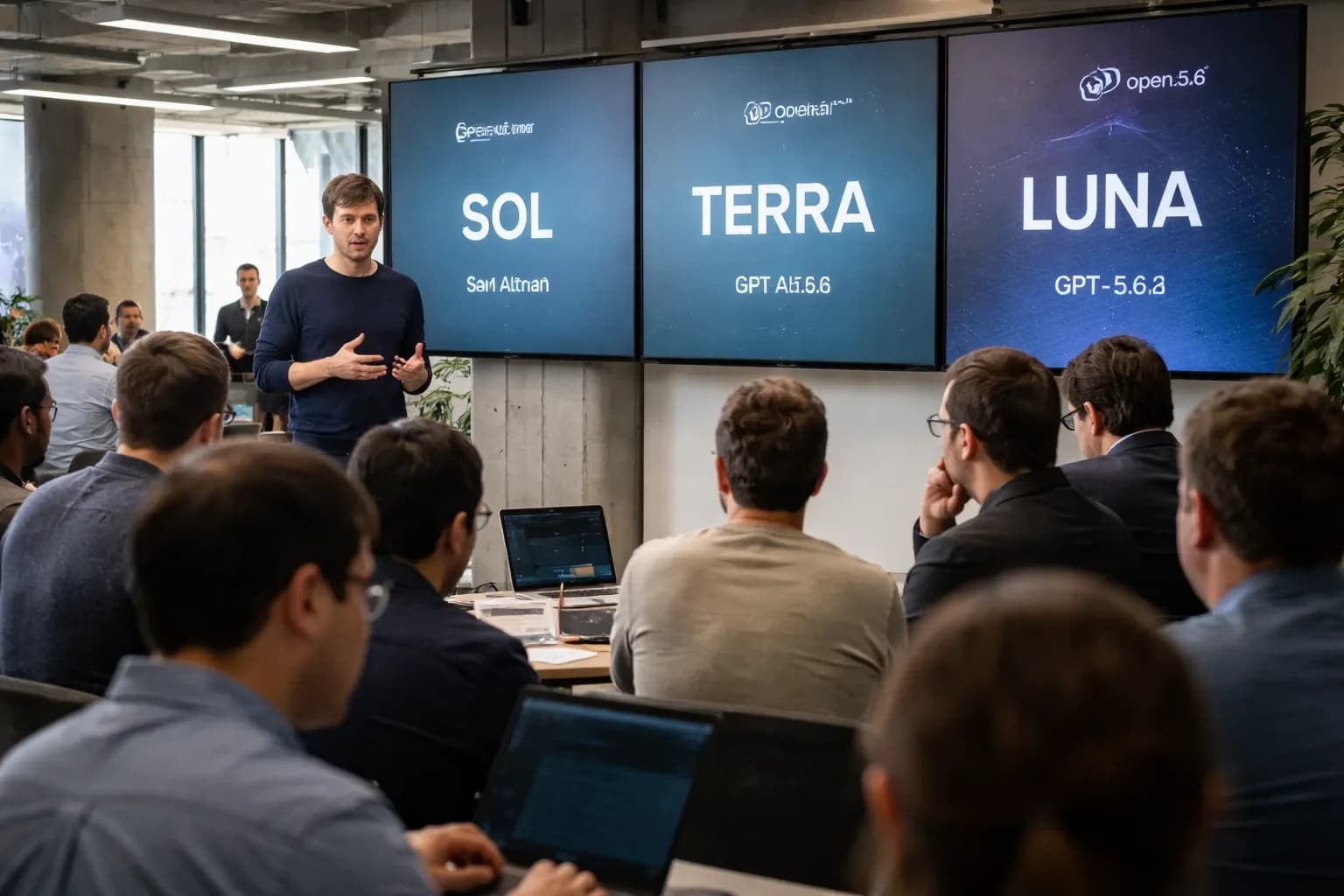
OpenAI expanded its artificial intelligence portfolio on Thursday with the official launch of the GPT-5.6 family, a suite of models aimed at reclaiming the performance lead in an increasingly crowded market. This new generation includes three distinct tiers: Sol, which serves as the high-performance workhorse; Terra, a balanced intermediate option; and Luna, a budget-friendly model for high-volume tasks. These releases come at a critical juncture for the company as it faces mounting competition from rivals like SpaceXAI and Meta. The announcement emphasizes practical application over pure theoretical scaling, with OpenAI highlighting improvements in enterprise workflows, software development, and scientific research capabilities that differentiate these models from their predecessors as the company aims to solidify its position as the industry leader.
What's new in this update
The primary differentiator for the GPT-5.6 rollout is its heavy focus on frontier performance in cybersecurity and coding efficiency. CEO Sam Altman has claimed that the Sol model achieves a 54% improvement in token efficiency for coding tasks, a metric that directly impacts the cost and speed of large-scale software development. Furthermore, the company introduced ChatGPT Work, a dedicated workplace application designed for desktop, web, and mobile environments. This tool is built to integrate directly into corporate workflows, assisting with clerical tasks such as drafting complex documentation, managing spreadsheets, and generating presentations. Unlike standard consumer versions, ChatGPT Work is optimized for the GPT-5.6 architecture to handle enterprise-grade security and data privacy requirements for global professional teams.
Key details
OpenAI is leveraging the Artificial Analysis Coding Agent Index to position GPT-5.6 as the new industry benchmark. According to company data, the Sol model achieved a state-of-the-art score of 80 on this index, surpassing Anthropic’s Fable 5 by 2.8 points. Notably, OpenAI claims this performance was achieved using less than half the output tokens and at approximately one-third of the cost of its nearest competitor. The pricing structure for the new models reflects this push for market dominance: Sol is priced at $5 per million input tokens and $30 per million output tokens, while the budget-friendly Luna model drops significantly to $1 for input and $6 for output. This tiered pricing is clearly designed to appeal to both high-end research firms and cost-sensitive startups looking for scalable AI solutions.
Background and context
The launch of GPT-5.6 arrives amid a heated rivalry between OpenAI and Anthropic, the latter of which has recently gained significant traction among enterprise customers with its Fable and Opus models. Anthropic has often been framed as a more specialized alternative to OpenAI’s broader platform, but the GPT-5.6 release suggests a direct challenge to that narrative. Additionally, the cybersecurity capabilities of these new models have been a point of contention with federal regulators. The Trump administration previously expressed concerns regarding the potential for advanced AI to be misused in cyberattacks, leading to a period of restricted rollout. OpenAI has responded by framing GPT-5.6 as a defensive asset capable of threat modeling, code review, and blue teaming to find system weaknesses before malicious actors can.
What to watch next
In the coming months, the industry will be watching to see how enterprise clients migrate toward the GPT-5.6 ecosystem versus competing offerings from Anthropic and Meta. The success of ChatGPT Work will be a key indicator of whether OpenAI can maintain its foothold in the corporate software space as a primary productivity tool. Furthermore, the defensive cybersecurity applications of the Sol and Terra models will likely face scrutiny from both security researchers and government agencies to ensure that the promised blue teaming benefits outweigh the risks of dual-use technology. As OpenAI integrates these models across its API and Codex platforms, the actual realized cost savings for developers will determine if Sol truly remains the dominant coding model for the next generation of software engineering.
Why it matters
This release intensifies the competition between OpenAI and Anthropic, specifically targeting the high-stakes enterprise and cybersecurity sectors.
Read next
Follow this story through the topic hub, more ai coverage, and the latest updates.
Weekly briefing
Get the week's key developments in one concise email.
Get a fast catch-up on the biggest stories, the context behind them, and the links worth your time.
Cadence
Weekly, for a quick catch-up
Coverage
AI, business, world, security, sports
Format
Clear takeaways and useful context
Request the briefing
Leave your email to open a prepared request and get on the list for the weekly briefing.
About the byline
AI reporter
Alex Rivera reports on artificial intelligence with an emphasis on model launches, frontier lab strategy, developer tooling, and the policy decisions shaping commercial deployment.
Sources and methodology