AI Re-creations of Deceased Pilot Voices Prompt NTSB Docket Shutdown
Federal investigators restricted access to dozens of crash files after users converted visual spectrograms back into cockpit audio recordings.

AI reporter
Reports on model launches, frontier labs, developer platforms, and AI policy with an emphasis on claims verification and rollout context.
Editorial responsibility: Lead reviewer for AI coverage, launch claims, and policy context
Primary source: TechCrunch AI. Full source links and update notes are below.
Fast summary
Start here
- The National Transportation Safety Board (NTSB) temporarily disabled its public docket system after discovering AI-generated audio of deceased pilots circulating online.
- Users utilized spectrogram images and public transcripts to recreate cockpit voice recorder audio from UPS Flight 2976 using tools like Codex.
- While general access has been restored, 42 investigations remain closed to the public pending a review of sensitive data.
What happened
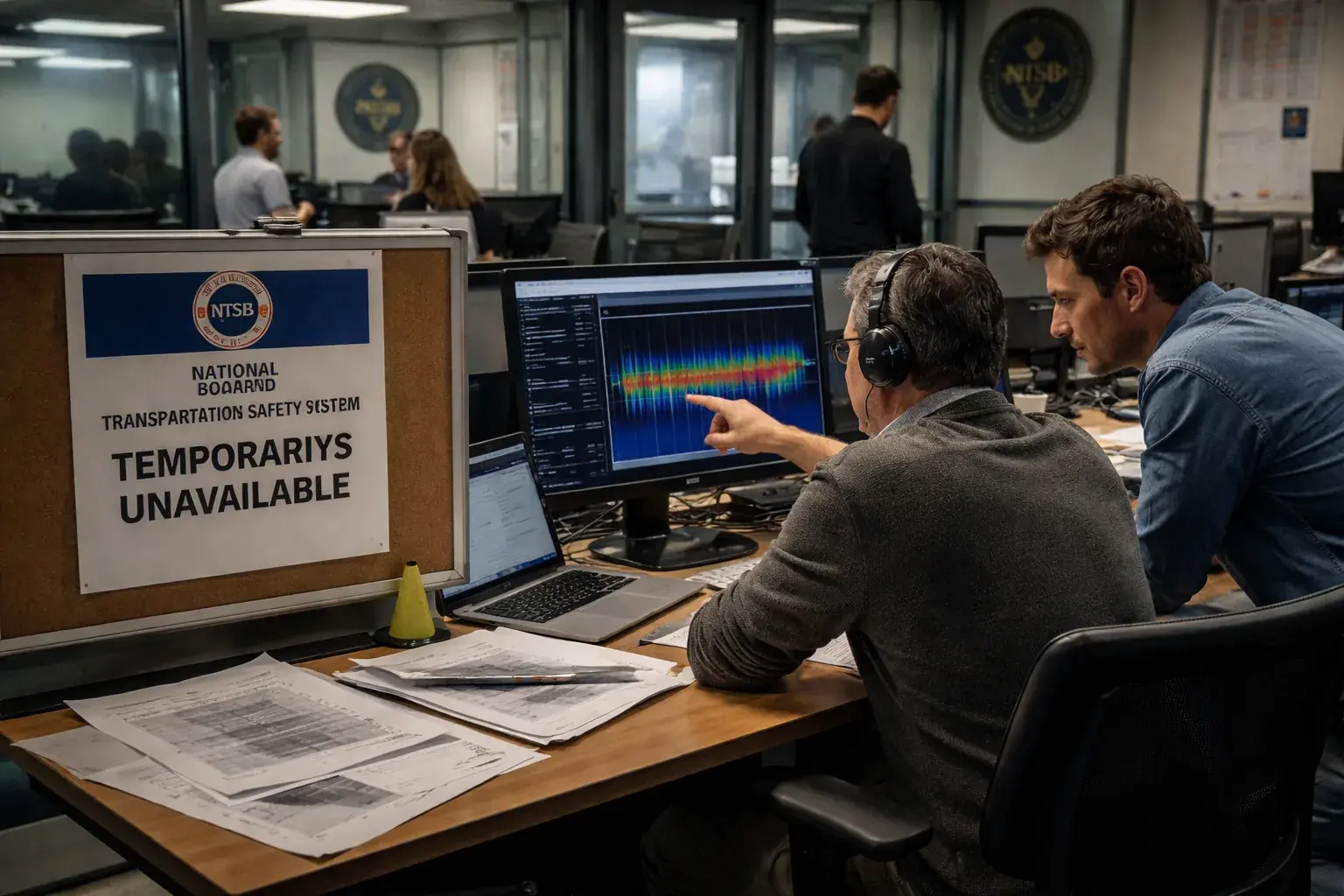
The National Transportation Safety Board temporarily shut down access to part of its public investigation database after online users used AI tools to reconstruct voice-like audio from deceased pilots. The material did not come from officially released cockpit voice recorder files, which federal law protects from public disclosure. Instead, people combined publicly available spectrogram images with written transcripts and then used modern AI and signal-processing techniques to approximate what the final cockpit audio may have sounded like.
That outcome exposed a gap between what agencies considered safe technical disclosure in the past and what is now possible with current generative and reconstruction tools. Data that once seemed abstract, partial, or too specialized to create a privacy risk can now be transformed into something emotionally vivid and socially viral.
What's new in this update
The NTSB has restored much of its docket system, but it is still keeping dozens of investigations offline while it reviews whether other files could be used in similar ways. That partial reopening suggests the agency is trying to balance two obligations that now appear to be in conflict: transparency for aviation safety research and protection of victims, families, and legally restricted evidence.
The immediate trigger appears to have been online circulation of recreated audio tied to UPS Flight 2976. Even if the reconstructed clips were not perfect or fully authentic, they were close enough to raise serious ethical and policy concerns. The issue is not only whether the clips were technically exact. It is that the public could now generate an approximation of moments the law explicitly intended to shield from public release.
Key details
Spectrograms are visual representations of sound frequency and intensity over time. Historically they were treated as technical reference material useful to investigators, researchers, and safety analysts rather than as substitutes for protected recordings. AI changes that assumption because machine learning models can infer missing audio characteristics, combine them with transcript context, and output something that feels substantially more like a recovered recording than a scientific chart.
Several issues make the situation significant:
- Federal law protects cockpit voice recorder audio precisely because of its sensitivity.
- Public transcripts and spectrograms together can now function as reconstruction inputs.
- AI lowers the technical barrier for reverse-engineering audio from non-obvious source material.
- Agencies may need to rethink long-standing disclosure practices for technical evidence.
This is why the NTSB response matters beyond a single docket. The agency is confronting a broader change in how public records can be repurposed once powerful inference tools are widely available.
Background and context
The NTSB's docket system has long served aviation safety by making investigative material accessible to researchers, journalists, families, lawyers, and industry specialists. Transparency helps the aviation sector learn from accidents and improve procedures, equipment, and training. But transparency frameworks were built in an earlier technological context, when converting a static image of a spectrogram into emotionally recognizable audio required specialist effort and still produced limited results.
Generative AI compresses that difficulty. It can bridge gaps between partial data formats, make guesses that sound plausible to human ears, and package the results in ways that spread quickly online. That forces regulators to reconsider whether "not the original file" is still a meaningful safeguard. In many cases, the functional effect may now be close enough to create the same privacy harm.
What to watch next
The next question is how the NTSB and similar agencies redesign their publication rules. They may redact or omit spectrograms, reduce metadata, delay releases, or create controlled-access channels for researchers who can justify legitimate safety use. Any of those options would represent a meaningful shift in the norms of public accident reporting.
The broader policy debate will extend beyond aviation. Courts, hospitals, law enforcement agencies, and scientific archives all publish technical artifacts that were never intended to be reassembled into highly sensitive media. As reconstruction models improve, more institutions may discover that old assumptions about anonymization and harmless disclosure no longer hold.
Why this matters
This matters because the incident shows how AI can defeat privacy protections without directly breaking into restricted systems. By combining legal public records with modern reconstruction tools, users were able to get close to material the law meant to keep private. For the NTSB, aviation safety, and digital ethics more broadly, the challenge is now clear: transparency policies must be redesigned for a world where technical traces are no longer safely abstract.
Reader context
This story belongs to Northstar Herald's Generative AI and Artificial Intelligence coverage, with related entities including NTSB, Aviation Safety, UPS Flight 2976, Spectrograms. The report is based on TechCrunch AI source material.
Related coverage
Why it matters
This incident reveals a privacy loophole where technical data intended for research can be reverse-engineered by AI to bypass federal laws protecting crash victim audio.
Read next
Follow this story through the topic hub, more ai coverage, and the latest updates.
Weekly briefing
Get the week's key developments in one concise email.
Get a fast catch-up on the biggest stories, the context behind them, and the links worth your time.
Cadence
Weekly, for a quick catch-up
Coverage
AI, business, world, security, sports
Format
Clear takeaways and useful context
Request the briefing
Leave your email to open a prepared request and get on the list for the weekly briefing.
About the byline
AI reporter
Alex Rivera reports on artificial intelligence with an emphasis on model launches, frontier lab strategy, developer tooling, and the policy decisions shaping commercial deployment.
Sources and methodology