xAI Operates Nearly 50 Unregulated Gas Turbines at Mississippi Data
The NAACP has requested a court injunction against the AI startup, alleging that mobile turbines are being used to circumvent environmental regulations.

AI reporter
Reports on model launches, frontier labs, developer platforms, and AI policy with an emphasis on claims verification and rollout context.
Editorial responsibility: Lead reviewer for AI coverage, launch claims, and policy context
Primary source: TechCrunch AI. Full source links and update notes are below.
Fast summary
Start here
- xAI is currently operating 46 natural gas turbines at its Mississippi facility, a significant increase from previous reports.
- The state of Mississippi classifies the trailer-mounted turbines as mobile, allowing them to bypass air pollution regulations for one year.
- The NAACP and Southern Environmental Law Center are seeking a court injunction, arguing the turbines violate federal stationary-source laws.
What happened
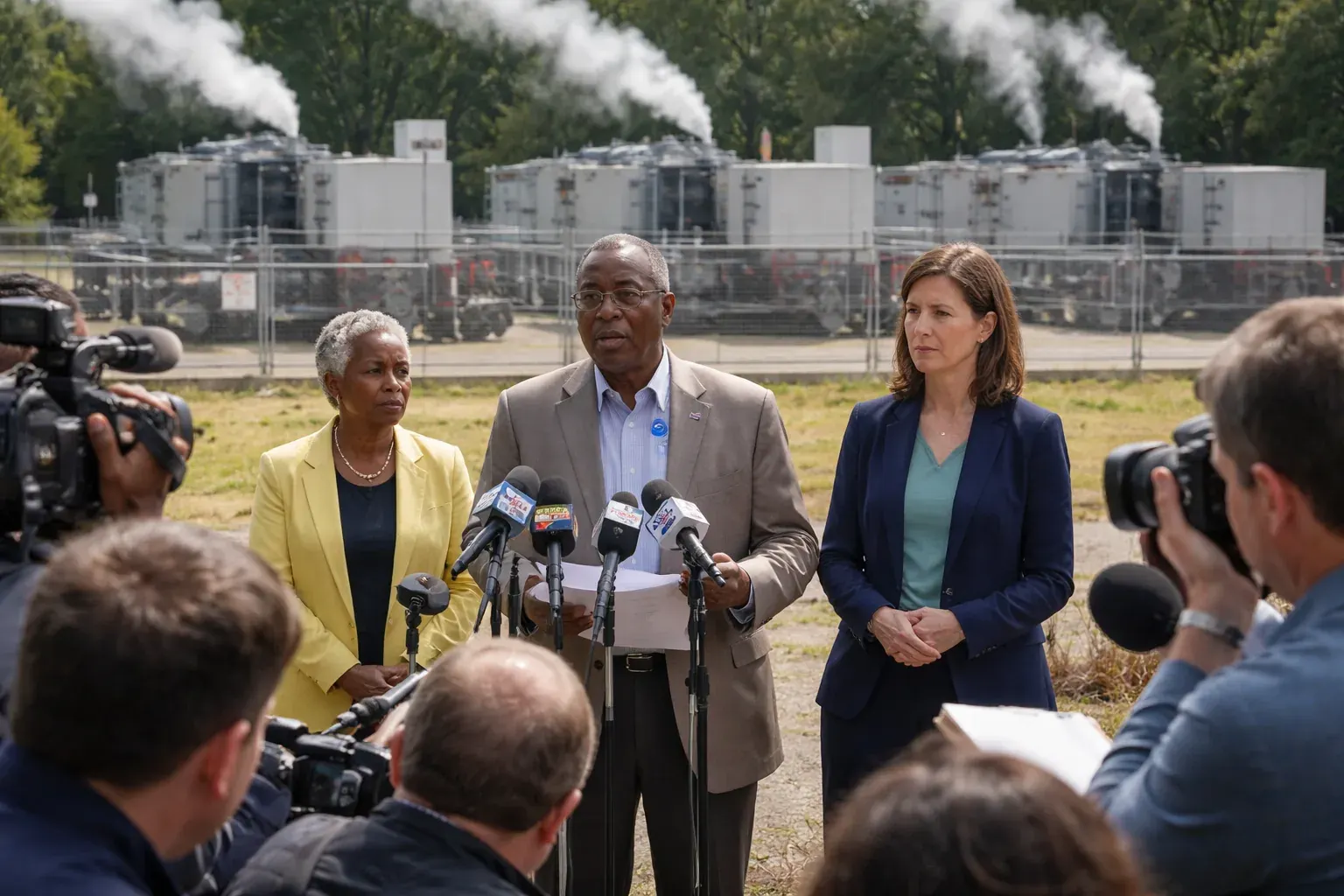
Elon Musk's xAI is facing a legal challenge over the rapid expansion of gas-fired power generation at its Mississippi data center, where the company is reportedly operating 46 natural gas turbines to support AI training and compute workloads. The lawsuit, backed by the NAACP and the Southern Environmental Law Center, asks a court to block the operation on the grounds that the emissions burden is being imposed on nearby communities without proper regulatory review.
At the center of the dispute is a simple but consequential question: can a company avoid stricter air-permit requirements by treating trailer-mounted turbines as mobile equipment even when they remain in one place powering a large data facility? That classification issue may sound technical, but it could determine how aggressively fast-growing AI companies can build emergency or interim power systems when local grids cannot meet their demands.
What's new in this update
Recent reporting indicates that xAI has expanded to 46 turbines, well above earlier public estimates. That matters because the scale of the installation changes the environmental and legal stakes. What may have initially looked like a temporary workaround now resembles a major on-site fossil-fuel power operation built to sustain a high-intensity AI cluster.
The NAACP's request for an injunction also gives the conflict a broader civil-rights dimension. The challenge is not framed only as an environmental permitting dispute. It is also framed as a question of whether residents in an already burdened area are being asked to absorb pollution exposure while a major technology company accelerates infrastructure deployment.
Key details
Mississippi's current interpretation reportedly treats the flatbed-mounted units as mobile sources, which can exempt them from some air-quality requirements for a limited period. Environmental advocates argue that this interpretation conflicts with federal principles governing stationary sources, which can apply even when equipment is technically movable if it effectively stays put and operates as part of a fixed industrial site.
The controversy highlights several overlapping pressures:
- AI data centers need immense power, often faster than utilities can deliver new capacity.
- Temporary fossil-fuel generation can be deployed quickly, making it attractive for compute-hungry operators.
- Local communities and regulators are left to deal with the pollution consequences of speed-first infrastructure choices.
- Regulatory definitions written for older industrial settings may not cleanly fit modular power systems serving AI campuses.
Reports also suggest xAI has permits for only part of the turbine fleet, increasing scrutiny over how much of the operation is formally authorized versus temporarily tolerated.
Background and context
This dispute lands in the middle of a much larger trend. As AI companies train bigger models and build denser clusters, electricity is becoming a defining constraint. Utilities, transmission timelines, and permitting systems were not designed for the pace at which frontier AI infrastructure is now being deployed. In response, some firms are turning to gas turbines, backup generators, and other stopgap power arrangements to avoid waiting years for new grid connections.
That creates a collision between climate commitments, local environmental justice concerns, and the economics of the AI race. Companies want compute now. Communities want clean air and enforceable safeguards. Regulators are being pushed to decide whether old definitions and exemptions can be stretched to accommodate an entirely new category of industrial demand.
What to watch next
The immediate focus is the court's decision on the injunction request. A ruling against xAI could force the company to shut down part of its power setup or move rapidly into fuller compliance. A ruling in xAI's favor could encourage other data-center operators to use similar modular gas strategies while regulators catch up.
Why this matters
This case is one of the clearest examples yet of the hidden cost of the AI buildout. Behind the narrative of advanced models and data-center expansion sits a harder question about who bears the environmental burden when companies race to secure power faster than infrastructure and regulation can adapt.
Reader context
This story belongs to Northstar Herald's AI Infrastructure and Artificial Intelligence coverage, with related entities including Elon Musk, xAI, Mississippi, NAACP. The report is based on TechCrunch AI source material.
Related coverage
Why it matters
This case highlights the environmental trade-offs of the AI arms race and the legal strategies companies use to secure immediate power for massive data centers.
Read next
Follow this story through the topic hub, more ai coverage, and the latest updates.
Weekly briefing
Get the week's key developments in one concise email.
Get a fast catch-up on the biggest stories, the context behind them, and the links worth your time.
Cadence
Weekly, for a quick catch-up
Coverage
AI, business, world, security, sports
Format
Clear takeaways and useful context
Request the briefing
Leave your email to open a prepared request and get on the list for the weekly briefing.
About the byline
AI reporter
Alex Rivera reports on artificial intelligence with an emphasis on model launches, frontier lab strategy, developer tooling, and the policy decisions shaping commercial deployment.
Sources and methodology