Microsoft Unveils Three New Foundational AI Models to Rival OpenAI
Microsoft AI releases MAI-Transcribe-1, MAI-Voice-1, and MAI-Image-2, offering faster and cheaper multimodal solutions to compete with OpenAI and Google.

AI reporter
Reports on model launches, frontier labs, developer platforms, and AI policy with an emphasis on claims verification and rollout context.
Editorial responsibility: Lead reviewer for AI coverage, launch claims, and policy context
Primary source: TechCrunch AI. Full source links and update notes are below.
Fast summary
Start here
- Microsoft AI released MAI-Transcribe-1, MAI-Voice-1, and MAI-Image-2 to build its own independent multimodal stack.
- The models were developed by the MAI Superintelligence team led by Mustafa Suleyman and are being positioned as cheaper alternatives to Google and OpenAI.
- Despite the new internal models, Microsoft reaffirmed its commitment to its multi-year, multi-billion dollar partnership with OpenAI.
What happened
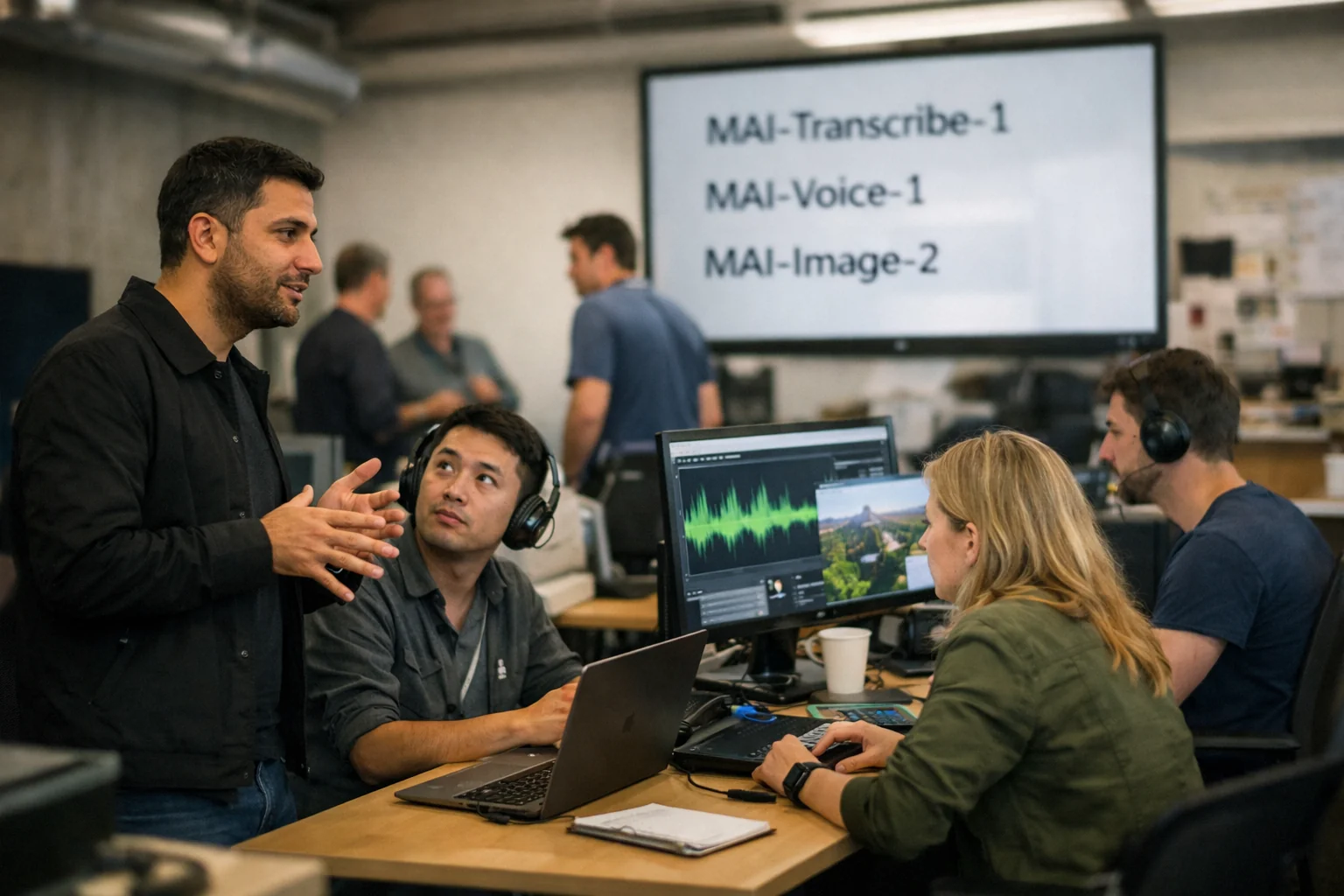
Microsoft has introduced three new foundational AI models under its own MAI branding, signaling a deeper push to build an internal multimodal stack rather than relying exclusively on external partners such as OpenAI. The releases, including MAI-Transcribe-1, MAI-Voice-1, and MAI-Image-2, are being framed as practical enterprise models that can compete with offerings from OpenAI and Google while fitting more tightly into Microsoft's own platform strategy.
That does not mean Microsoft is abandoning OpenAI. It does mean the company is making a more explicit effort to ensure that one of the world's most AI-dependent cloud platforms is not strategically dependent on a single outside model supplier.
What's new in this update
The major shift is that Microsoft is now publicly releasing a set of foundational models that sit closer to core infrastructure than ordinary product features. Developed by the MAI Superintelligence group associated with Mustafa Suleyman, the models are positioned around performance, multimodal capability, and cost. Microsoft is not only saying these tools work. It is saying they can work cheaply and fast enough to matter for enterprise deployment at scale.
That positioning matters because the next stage of AI competition is not just about who has the strongest frontier model in a benchmark race. It is about who can offer complete, operational stacks for speech, image, automation, and application-building inside large enterprise platforms.
Key details
The models span transcription, voice generation, and image-related capability, which makes the release feel less like a research flourish and more like a productized building-block strategy. By routing them through Microsoft Foundry and related testing surfaces, the company is making them part of its enterprise development ecosystem rather than keeping them as internal demos.
Several themes define the significance of the launch:
- Microsoft is building branded first-party models instead of relying solely on partner access.
- Mustafa Suleyman's team is being used to create strategic AI independence.
- Price and speed are part of the competitive pitch against OpenAI and Google.
- The models strengthen Microsoft's ability to sell an end-to-end enterprise AI platform.
This matters because platform control is one of Microsoft's deepest advantages. If it can pair cloud distribution with its own models, it reduces risk in negotiations and gains more freedom in pricing, bundling, and roadmap timing.
Background and context
Microsoft's relationship with OpenAI has been one of the defining alliances of the AI era, but alliances create dependency as well as advantage. Over time, it became increasingly clear that Microsoft would want optionality: the ability to build, ship, and optimize its own models for at least some major product categories. That optionality is especially valuable if model providers diverge on pricing, safety posture, exclusivity, or product direction.
Mustafa Suleyman's arrival gave Microsoft both leadership narrative and strategic cover for this move. His role suggested that Microsoft intended not merely to distribute AI, but to own more of the underlying intelligence layer. These model launches are one of the clearest public signs that the strategy is taking shape.
What to watch next
The next important question is adoption. Developers and enterprises will judge these models not only on benchmark claims, but on cost, latency, integration ease, and how well they compare to incumbents already embedded in workflows. If Microsoft can win real usage rather than curiosity, the models become more than hedges. They become power centers inside its cloud and productivity stack.
It will also be worth watching how OpenAI responds in practice. Public partnership rhetoric may remain warm even as competitive overlap grows more direct.
Why this matters
This matters because Microsoft AI, Mustafa Suleyman, Microsoft Foundry, OpenAI, Google, and the future of enterprise multimodal AI are all converging around a strategic question: how much of the AI stack does Microsoft want to own itself? These new foundational models suggest the answer is "more than before." That shift could reshape both Microsoft's bargaining power and the broader balance of power in enterprise AI infrastructure.
Reader context
This story belongs to Northstar Herald's Artificial Intelligence and Microsoft AI coverage, with related entities including AI Models, Cloud Computing, Mustafa Suleyman, Microsoft Foundry. The report is based on TechCrunch AI source material.
Related coverage
Why it matters
This move signals a significant strategic shift where Microsoft is diversifying its AI portfolio to reduce reliance on OpenAI while building a vertically integrated stack.
Read next
Follow this story through the topic hub, more ai coverage, and the latest updates.
Weekly briefing
Get the week's key developments in one concise email.
Get a fast catch-up on the biggest stories, the context behind them, and the links worth your time.
Cadence
Weekly, for a quick catch-up
Coverage
AI, business, world, security, sports
Format
Clear takeaways and useful context
Request the briefing
Leave your email to open a prepared request and get on the list for the weekly briefing.
About the byline
AI reporter
Alex Rivera reports on artificial intelligence with an emphasis on model launches, frontier lab strategy, developer tooling, and the policy decisions shaping commercial deployment.
Sources and methodology