Genesis AI Goes Full Stack with Humanoid Robotic Hands and New Model
The Khosla-backed startup is moving beyond software to build its own dexterity-focused hardware and data-collection gloves.

AI reporter
Reports on model launches, frontier labs, developer platforms, and AI policy with an emphasis on claims verification and rollout context.
Editorial responsibility: Lead reviewer for AI coverage, launch claims, and policy context
Primary source: TechCrunch AI. Full source links and update notes are below.
Fast summary
Start here
- Genesis AI unveiled the GENE-26.5 model alongside proprietary robotic hands designed to mimic human size and shape.
- The company is adopting a full-stack approach to reduce the embodiment gap between AI training and physical performance.
- A new sensor-loaded glove allows the company to collect high-fidelity human movement data from workers in labs and factories.
What happened
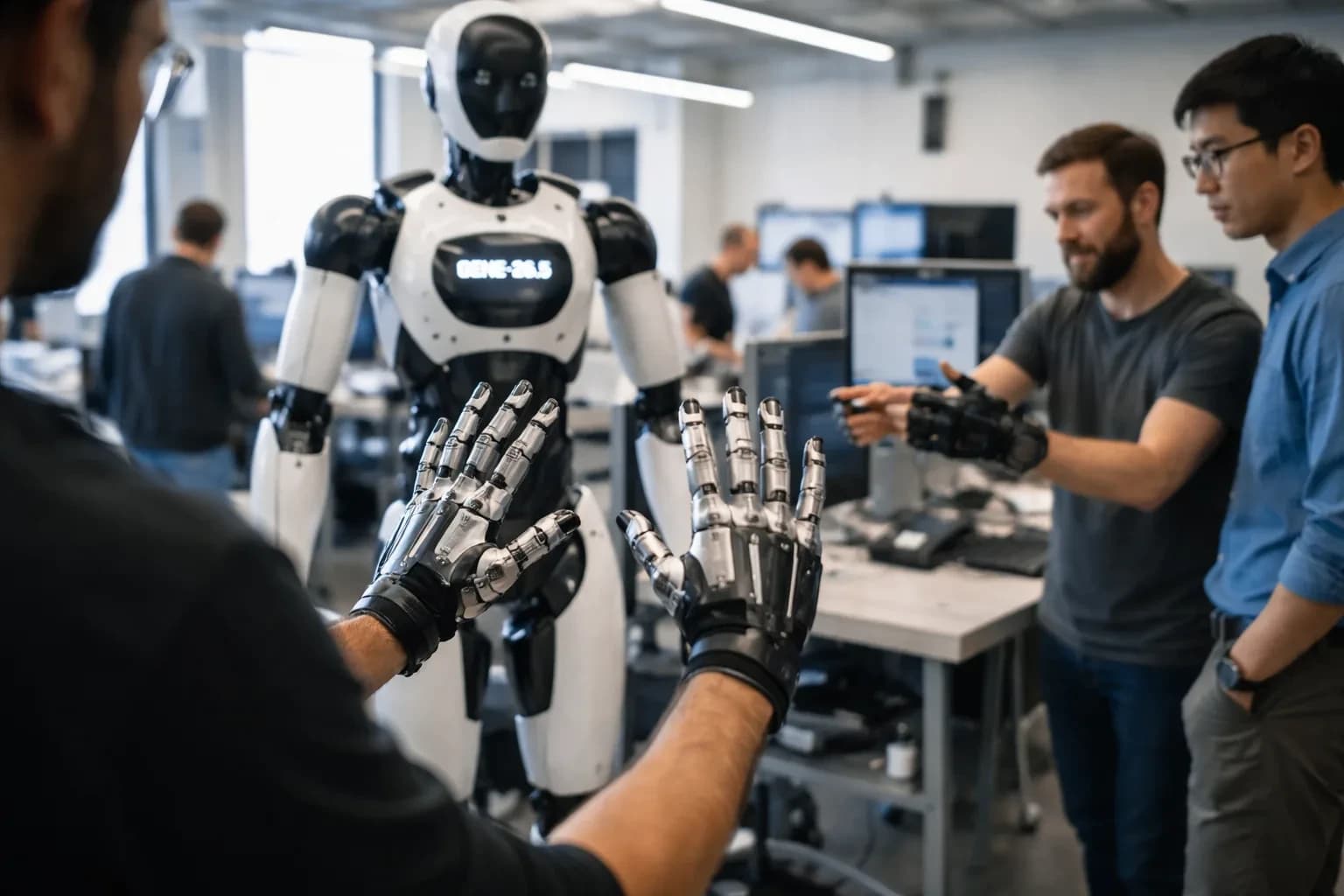
Genesis AI, a robotics startup backed by Khosla Ventures, has introduced a new version of its robotics model, GENE-26.5, alongside custom humanoid robotic hands and a wearable data-collection glove. The announcement marks a clear strategic shift: instead of focusing mainly on software and simulation, the company is now building tightly integrated hardware and data systems intended to improve dexterity. In robotics, that is a major move because many of the hardest commercial tasks still depend on fine motor control rather than general reasoning alone.
The company is effectively arguing that robotic intelligence cannot be separated cleanly from embodiment. A model may plan well in simulation, but if the physical hand is too crude, too poorly instrumented, or too different from the human demonstrations used in training, performance breaks down quickly.
What's new in this update
The most notable addition is the custom hand design built to approximate human size, structure, and motion more closely than the simple grippers used in many industrial robots. Genesis AI says that choice reduces the mismatch between how humans demonstrate a task and how the robot is expected to perform it later. The startup also introduced a glove with sensors and egocentric video capture so it can collect high-quality movement data from human workers performing real tasks in labs and factories.
That data strategy is as important as the hardware itself. Robotics teams increasingly believe that scaling useful physical intelligence requires large volumes of detailed demonstration data, not just internet-scale text or video. If Genesis AI can capture richer hand trajectories and contextual views during real work, it may create a better training pipeline for long-horizon manipulation tasks.
Key details
GENE-26.5 was shown handling tasks that emphasize dexterity, including kitchen-like manipulation and fine object control. Demonstrations matter in robotics fundraising and recruiting, but the deeper message is about stack ownership. Genesis AI appears to believe it cannot rely on generic off-the-shelf hands and still solve the embodiment problem at the level required for advanced manipulation.
Several elements define the company's approach:
- Full-stack development ties the model, hand hardware, and training data pipeline together.
- Five-finger humanoid hands are meant to preserve compatibility with human demonstrations.
- Sensor gloves help gather data from practical work settings instead of only laboratory scripts.
- The target use cases include industrial automation, lab assistance, and other fine-motor tasks.
This is a more expensive and operationally complex strategy than being model-only, but it may also be more defensible if dexterity turns out to be the real bottleneck in useful robotics deployment.
Background and context
The robotics sector has been moving toward foundational-model language, with startups promising general-purpose control systems that can work across many robot forms and tasks. But repeated experience in the field shows that physical systems remain stubbornly domain-specific. The hand, the sensors, the actuation profile, and the training data all shape what the robot can actually do. That is why the "embodiment gap" has become such an important term: it captures the difference between digital competence and real-world physical execution.
Genesis AI is competing in a crowded field that includes other well-funded attempts to build general robotics intelligence. By partnering hardware choices with machine learning choices, it is betting that vertical integration will beat a modular approach. The involvement of Khosla Ventures and Wuji Tech also signals that investors still see room for differentiated infrastructure plays in humanoid robotics.
What to watch next
The next questions are commercial rather than theatrical. Can Genesis AI get customers to wear data-collection gloves during actual work? Can it prove that proprietary hands outperform simpler alternatives strongly enough to justify cost and maintenance? And can GENE-26.5 generalize beyond polished demos into repeatable industrial use?
Investors and partners will also watch how fast the company can iterate. In robotics, the feedback loop between data collection, simulation, hardware modification, and deployment often determines whether a startup becomes a product company or remains a research story.
Why this matters
This matters because Genesis AI is making a clear claim about the future of robotics: model intelligence alone is not enough. Humanoid robots need hardware designed for dexterity, data pipelines that capture real human manipulation, and machine learning systems trained on embodiment-compatible inputs. If GENE-26.5, the robotic hands, and the sensor glove work as intended, Genesis AI could become a more serious contender in industrial automation and humanoid robot development rather than just another foundational-model startup.
Reader context
This story belongs to Northstar Herald's Robotics and Foundational Models coverage, with related entities including Genesis AI, Khosla Ventures, Wuji Tech, Machine Learning. The report is based on TechCrunch AI source material.
Related coverage
Why it matters
The transition to full-stack robotics suggests that foundational models alone are insufficient for complex physical tasks, requiring specialized hardware to achieve human-level dexterity.
Read next
Follow this story through the topic hub, more ai coverage, and the latest updates.
Weekly briefing
Get the week's key developments in one concise email.
Get a fast catch-up on the biggest stories, the context behind them, and the links worth your time.
Cadence
Weekly, for a quick catch-up
Coverage
AI, business, world, security, sports
Format
Clear takeaways and useful context
Request the briefing
Leave your email to open a prepared request and get on the list for the weekly briefing.
About the byline
AI reporter
Alex Rivera reports on artificial intelligence with an emphasis on model launches, frontier lab strategy, developer tooling, and the policy decisions shaping commercial deployment.
Sources and methodology