AI Industry Leaders Warn of Growing Infrastructure and Supply
At the Milken Institute Global Conference, key figures in the AI supply chain described a sector facing hard physical limits on chips, energy, and

AI reporter
Reports on model launches, frontier labs, developer platforms, and AI policy with an emphasis on claims verification and rollout context.
Editorial responsibility: Lead reviewer for AI coverage, launch claims, and policy context
Primary source: TechCrunch AI. Full source links and update notes are below.
Fast summary
Start here
- ASML CEO Christophe Fouquet expects the high-end chip market to remain supply-limited for the next two to five years.
- Google Cloud's backlog of committed revenue nearly doubled in one quarter, rising from $250 billion to $460 billion.
- Applied Intuition CEO Qasar Younis identified real-world data, rather than silicon, as the primary bottleneck for physical AI like autonomous vehicles.
What happened
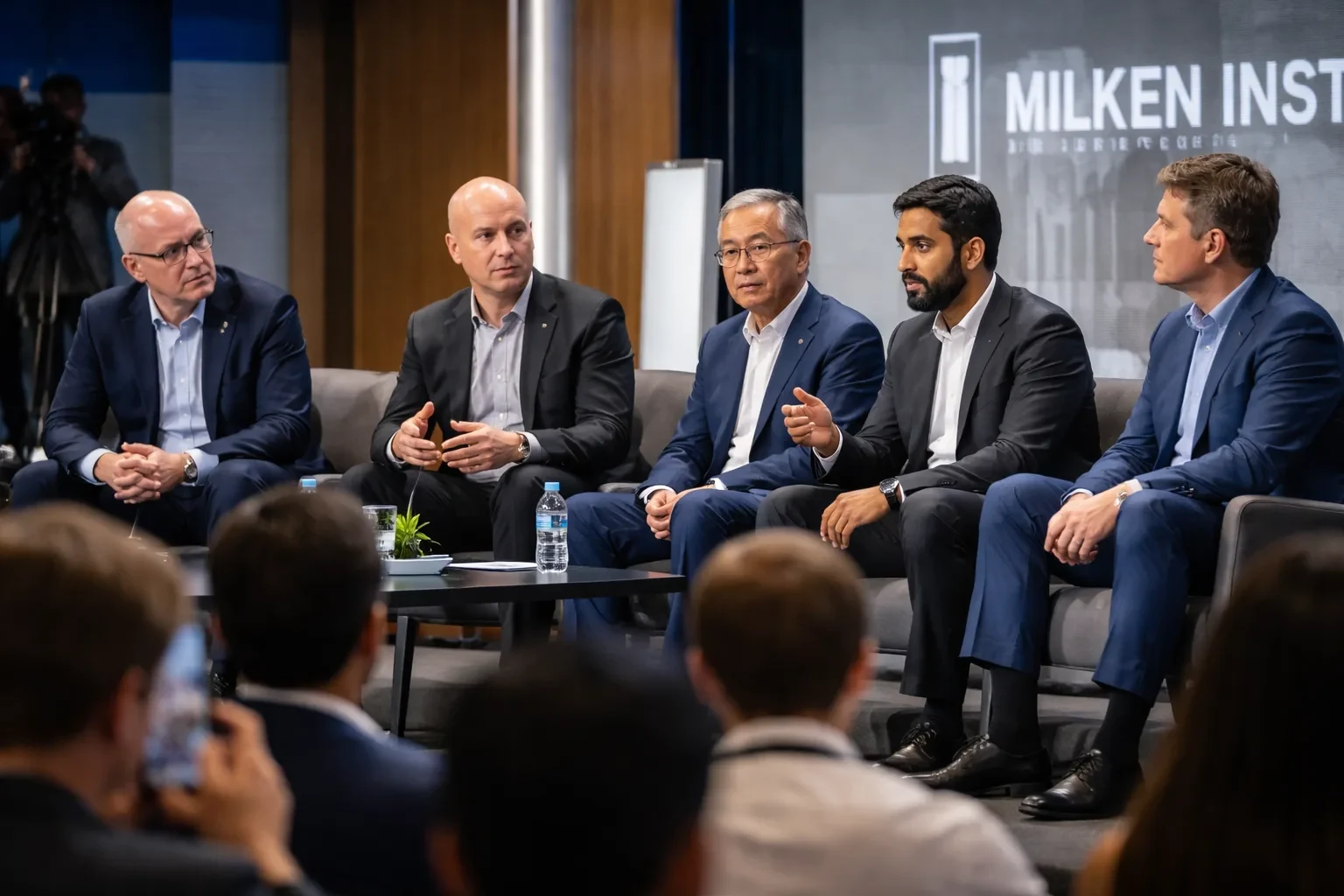
Five industry leaders at the Milken Institute laid out a reality that cuts against the most frictionless narratives about artificial intelligence: the AI economy is not bottlenecked only by clever models or investor appetite. It is bottlenecked by chips, energy, grid capacity, fabrication tools, delivery timelines, and in some cases the scarcity of real-world data. Executives from companies such as ASML, Google Cloud, and Applied Intuition described a sector that is colliding with hard physical constraints even as demand keeps accelerating.
That matters because the industry often talks as if scale is mainly a software problem. The discussion at Milken suggests the next stage of AI competition may be decided just as much by supply chains and infrastructure as by model quality.
What's new in this update
One of the clearest signals came from Google Cloud, where executives described a massive surge in committed demand that outpaces the company's near-term ability to deliver capacity. That kind of backlog is more than a good business problem. It is evidence that enterprise appetite for AI compute is outrunning the rate at which cloud providers can stand up the underlying systems.
Meanwhile, ASML's warning that advanced chip supply could stay tight for years reinforces a deeper point: even if hyperscalers have the cash, they cannot simply order their way past every chokepoint. And Applied Intuition's emphasis on real-world data for physical AI shows that not all bottlenecks are upstream semiconductor issues. Some are embedded in the difficulty of teaching machines how the physical world actually behaves.
Key details
The executives described different bottlenecks depending on their part of the stack, but the pattern was consistent: AI's expansion is being limited by scarce inputs. ASML controls a uniquely important layer of advanced chipmaking through lithography machines. Google Cloud faces the infrastructure burden of meeting hyperscale enterprise demand. Applied Intuition sees physical AI constrained by the long tail of real-world experience that simulation still cannot fully replace.
Several themes stand out:
- Advanced chip supply remains structurally tight, not just temporarily delayed.
- Cloud backlogs suggest demand is arriving faster than infrastructure can be deployed.
- Energy and grid access are becoming major gating factors for AI buildouts.
- Physical AI still depends on hard-to-replace real-world data rather than synthetic shortcuts alone.
This is why the industry increasingly sounds less like pure software and more like a capital-intensive industrial system with interlocking dependencies.
Background and context
The AI boom has been fueled by the assumption that more capital, more GPUs, and more engineering talent would keep producing stepwise gains. That remains partly true, but the supply chain beneath the boom is narrow. ASML's position in lithography, the concentration of advanced foundry capacity, the hunger of hyperscalers for power-hungry compute, and the limited pace of energy infrastructure expansion all create stress points. These are not easily solved by venture funding or better prompt engineering.
Physical AI adds a separate dimension. For robotics, autonomous vehicles, and industrial systems, training quality depends on complex real-world exposure. Synthetic data helps, but executives in the space increasingly argue that it cannot fully substitute for the messy, high-variance edge cases that real environments produce.
What to watch next
The next question is which bottlenecks ease first. If semiconductor supply expands faster than grid buildouts, power becomes the main limiter. If cloud capacity remains constrained, enterprises may delay deployments even when models improve. And if physical AI companies cannot secure enough real-world data, robotics progress may lag behind the more software-centric parts of the market.
It will also be worth watching whether the industry responds by re-architecting the stack around efficiency rather than brute-force scale. That could mean smaller models, more specialized systems, and deeper focus on deployment economics instead of frontier prestige.
Why this matters
This matters because ASML, Google Cloud, Applied Intuition, Perplexity, semiconductors, cloud computing, energy, and physical AI are all exposing the same truth: the AI economy is running into material limits. The biggest constraint is no longer only imagination or funding. It is whether the world can actually build, power, and feed the systems fast enough. That is the kind of bottleneck that can slow an entire technological wave regardless of how much money is chasing it.
Reader context
This story belongs to Northstar Herald's AI Infrastructure and Semiconductors coverage, with related entities including ASML, Google Cloud, Applied Intuition, Perplexity. The report is based on TechCrunch AI source material.
Related coverage
Why it matters
The AI boom is hitting physical and logistical limits that could slow the pace of global deployment for years, regardless of capital availability.
Read next
Follow this story through the topic hub, more ai coverage, and the latest updates.
Weekly briefing
Get the week's key developments in one concise email.
Get a fast catch-up on the biggest stories, the context behind them, and the links worth your time.
Cadence
Weekly, for a quick catch-up
Coverage
AI, business, world, security, sports
Format
Clear takeaways and useful context
Request the briefing
Leave your email to open a prepared request and get on the list for the weekly briefing.
About the byline
AI reporter
Alex Rivera reports on artificial intelligence with an emphasis on model launches, frontier lab strategy, developer tooling, and the policy decisions shaping commercial deployment.
Sources and methodology