Apple Overhauls Siri with Google Gemini and Previews iOS 27 at WWDC
Apple introduced a revamped Siri and confirmed iOS 27 will support devices as old as the iPhone 11 during CEO Tim Cook's final WWDC appearance.

AI reporter
Reports on model launches, frontier labs, developer platforms, and AI policy with an emphasis on claims verification and rollout context.
Editorial responsibility: Lead reviewer for AI coverage, launch claims, and policy context
Primary source: TechCrunch AI. Full source links and update notes are below.
Fast summary
Start here
- Siri is being integrated with Google Gemini models to provide more conversational capabilities and visual intelligence within a standalone app.
- iOS 27 will be compatible with all devices from the iPhone 11 onward, featuring significant performance increases in AirDrop and photo processing.
- Tim Cook confirmed he will step down as CEO on September 1, with John Ternus set to succeed him.
What happened
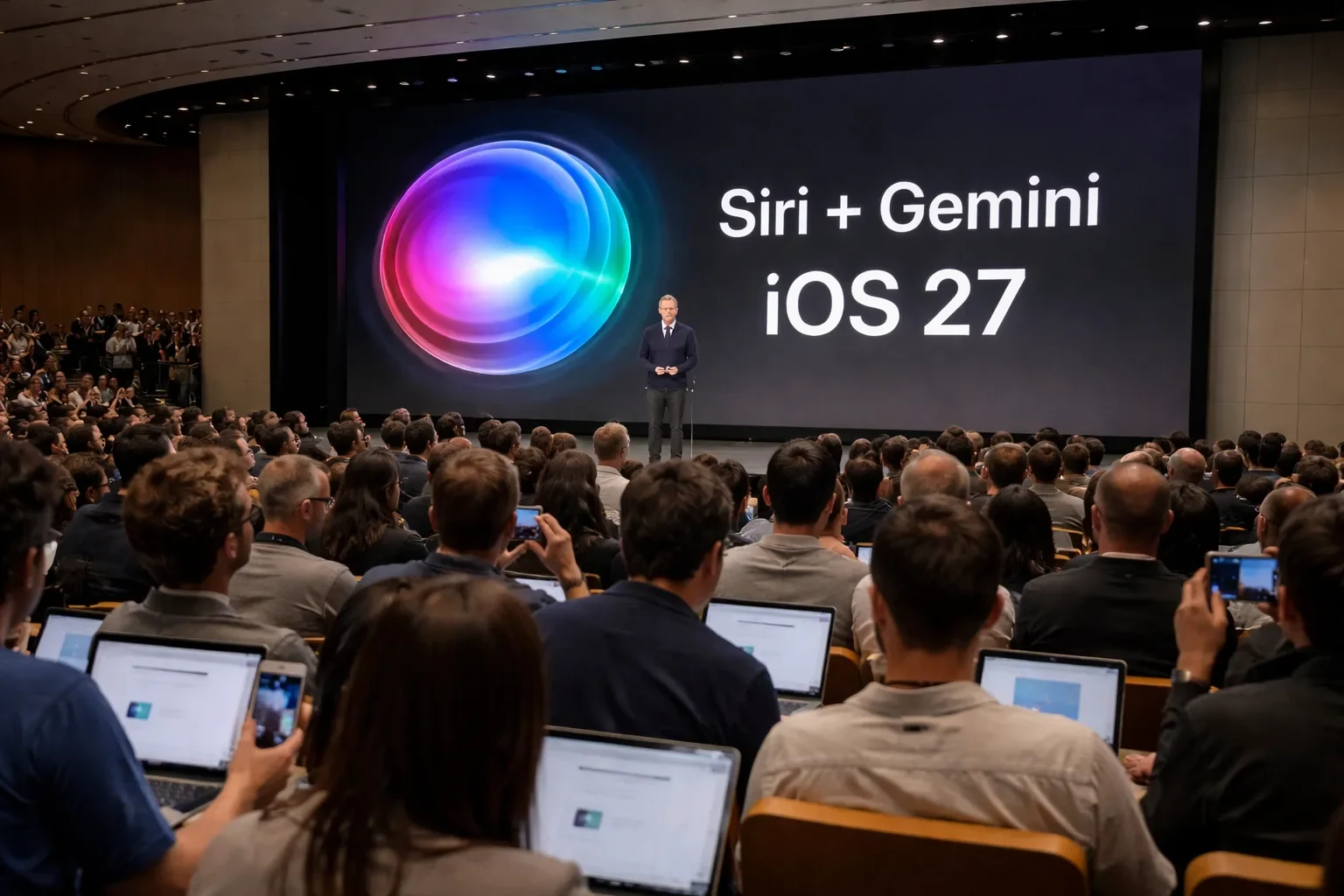
Apple used WWDC 2026 to show that its AI strategy is entering a more aggressive phase. The headline announcement was a rebuilt Siri AI experience tied to Google Gemini models, alongside the debut of iOS 27 and a broader expansion of Apple Intelligence features across the company's ecosystem. On its own, each piece would have been a major software update. Presented together, they signaled that Apple no longer wants to be seen as cautiously trailing the generative AI race.
The event also carried extra significance because it was framed as Tim Cook's final WWDC before stepping down as CEO, with John Ternus preparing to take over. That leadership context gave the Siri AI and iOS 27 announcements a strategic feel, not just a product-demo feel.
Why Siri AI is the center of the story
Siri has long been one of Apple's most criticized consumer products relative to rivals. While Apple dominated premium hardware, Siri often felt limited, rigid, and behind the conversational quality already visible in Google, OpenAI, and other AI systems. By pairing Siri with Google Gemini capabilities, Apple is effectively acknowledging that voice assistants now have to behave more like multi-step AI agents than like command interpreters.
That matters because Siri is not a side feature. It is Apple's most visible AI interface for mainstream users. If Siri improves meaningfully, it changes how consumers perceive the entire Apple Intelligence stack.
Why iOS 27 support matters
The iOS 27 compatibility message is almost as important as the Siri AI pitch. Apple said the new release will support devices as old as the iPhone 11, which reinforces one of the company's strongest long-term advantages: software longevity. In an AI era, many hardware companies are using new features to push faster upgrade cycles. Apple appears to be trying a more balanced approach by keeping older iPhones in the conversation while still delivering new AI tools.
That decision has two effects. It protects Apple's reputation for long support windows, and it widens the potential audience for Apple Intelligence features even if not every advanced capability runs identically on older devices.
The Google Gemini partnership question
The Google Gemini angle will likely attract the most scrutiny. Apple has traditionally preferred owning the core user experience rather than depending visibly on a rival. Bringing Gemini into Siri AI suggests Apple believes speed to market now matters enough to justify outside model support, at least in selected layers of the experience.
That is a meaningful strategic shift. It does not mean Apple is surrendering its AI ambitions. It does mean Apple is willing to blend internal design control, privacy branding, and external model capability if that combination helps Siri become competitive faster.
Privacy and Apple Intelligence
Apple's other major task at WWDC 2026 was defending its AI credibility without weakening its privacy identity. That is why the keynote repeatedly emphasized auditable protections, limited-use data handling, and careful control over what leaves the device. In Apple's view, Apple Intelligence has to be more than useful. It has to look safer, more explainable, and more governable than competing AI ecosystems.
Whether consumers fully accept that promise will depend on implementation, but the message was clear: Apple wants Siri AI and iOS 27 to feel modern without looking reckless.
Why the leadership transition matters
Because Tim Cook is preparing to hand over the CEO role to John Ternus, this WWDC carried succession pressure. Investors and developers were not just watching software. They were watching whether Apple's next leadership phase begins with momentum in AI or with another year of catch-up concerns. A stronger Siri AI launch helps answer that question, at least optically.
In that sense, WWDC 2026 was partly about continuity. Apple wanted to show that the transition from Cook to Ternus would not interrupt product ambition.
What to watch next
The next test is whether Siri AI performs well outside the keynote and whether iOS 27 features work consistently across supported devices, especially older iPhone models. Developers will also watch how deeply Apple Intelligence APIs are exposed and how dependent the final Siri experience is on Google Gemini over time.
For now, Apple used WWDC 2026 to deliver a clearer AI message than it had in previous cycles. Siri AI is being repositioned as a serious product again, iOS 27 is being tied to longevity as well as intelligence, and Apple's leadership transition is now linked directly to whether those promises hold up in the real world.
Why it matters
This marks a major shift in Apple's AI strategy by partnering with Google and extending software longevity for older hardware during a leadership transition.
Read next
Follow this story through the topic hub, more ai coverage, and the latest updates.
Weekly briefing
Get the week's key developments in one concise email.
Get a fast catch-up on the biggest stories, the context behind them, and the links worth your time.
Cadence
Weekly, for a quick catch-up
Coverage
AI, business, world, security, sports
Format
Clear takeaways and useful context
Request the briefing
Leave your email to open a prepared request and get on the list for the weekly briefing.
About the byline
AI reporter
Alex Rivera reports on artificial intelligence with an emphasis on model launches, frontier lab strategy, developer tooling, and the policy decisions shaping commercial deployment.
Sources and methodology