The Academy Awards Officially Ban AI-Generated Actors and Scripts
New rules from the Academy of Motion Picture Arts and Sciences mandate that only human-authored scripts and human-led performances are eligible for Oscars.

AI reporter
Reports on model launches, frontier labs, developer platforms, and AI policy with an emphasis on claims verification and rollout context.
Editorial responsibility: Lead reviewer for AI coverage, launch claims, and policy context
Primary source: TechCrunch AI. Full source links and update notes are below.
Fast summary
Start here
- Performances must be credited in legal billing and performed by humans with explicit consent to qualify for eligibility.
- Screenplays are now strictly required to be human-authored for any Academy Award consideration.
- The Academy reserves the right to demand detailed disclosures regarding AI usage and human authorship during a film's production.
What happened
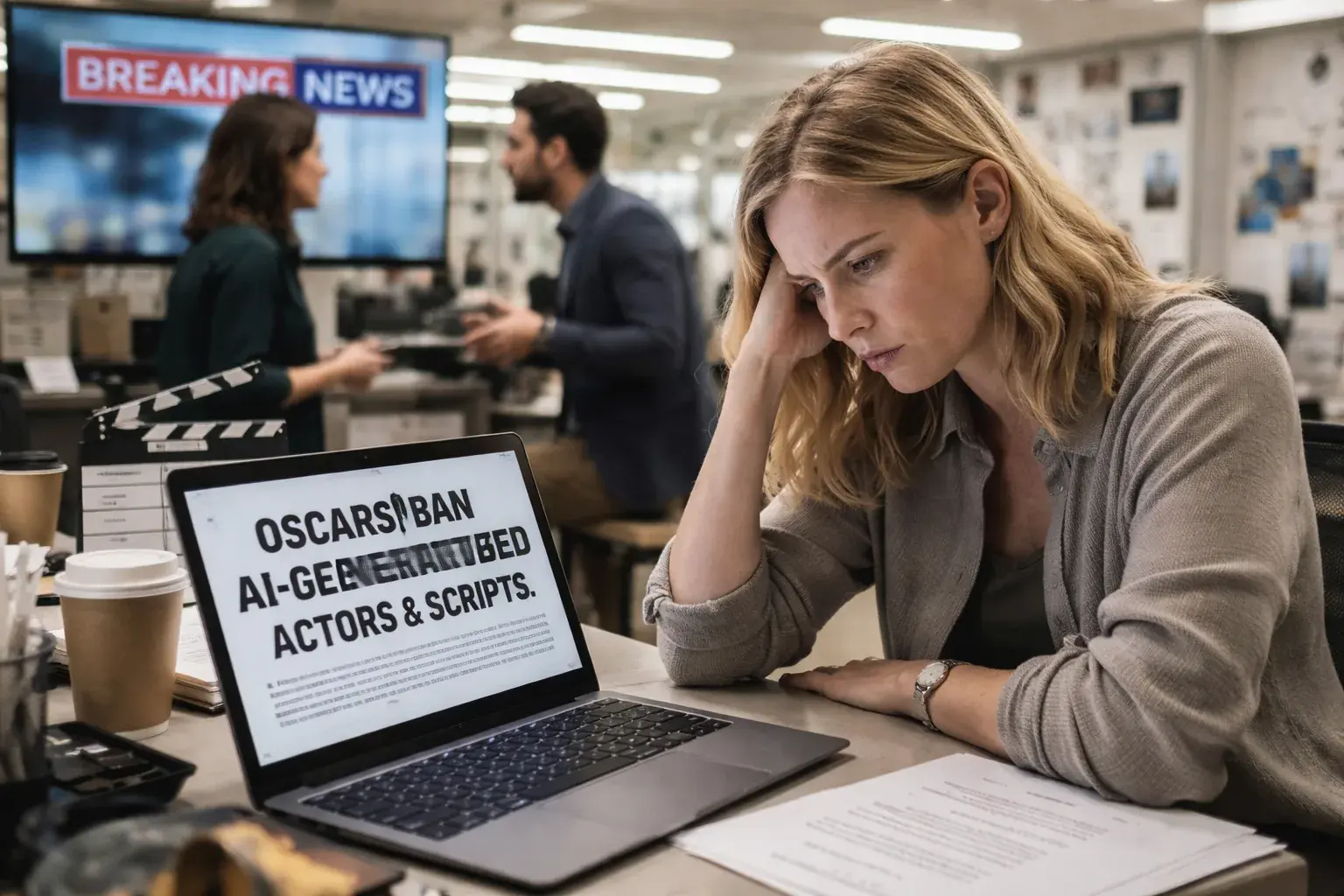
The Academy of Motion Picture Arts and Sciences has ruled that AI-generated actors and scripts are now ineligible for Academy Awards, drawing a formal line around what counts as award-worthy authorship and performance in the age of generative media. Under the new framework, performances must be human-led and scripts must be human-authored if they are to qualify for Oscar consideration.
That makes the Academy Awards AI rule change much more than a technical eligibility update. It is one of the clearest institutional statements yet that major creative honors will not treat generative output as equivalent to human artistic labor, at least not in the core categories where writing and performance define a film's authorship.
Why the new Oscar rules matter
The Academy does not regulate the entire film industry, but it does shape prestige, incentives, and the symbolic boundaries of what elite filmmaking is supposed to value. When the Oscars say AI actors and AI-written scripts are ineligible, they are not just answering a hypothetical. They are signaling to studios, producers, and talent that there is now a reputational cost to pushing too far toward replacement rather than augmentation.
That matters because awards logic affects production choices. If a film's creators believe that heavy AI substitution could make key categories ineligible, that can influence contracts, development strategy, and the balance between automation and human contribution.
Why this is connected to the strike era
The timing and tone of the policy cannot be separated from the recent Hollywood labor battles over generative AI. Writers and actors have already made clear that AI is not just a tool question. It is a question about authorship, consent, compensation, and the future of creative work. The Academy's decision effectively absorbs some of that labor logic into awards policy.
This matters because it turns principles debated in guild negotiations into public institutional standards. It says that human work is not only contractually protected. It is also culturally privileged in the industry's highest honor system.
What the rule is really trying to prevent
At the center of the issue is substitution. AI-assisted workflows are one thing; fully AI-generated scripts or synthetic performances standing in for credited human artistry are another. The Academy appears to be trying to stop the latter from sliding into awards legitimacy through ambiguity, technical workaround, or clever billing.
That is why disclosure requirements matter so much. The rule is not just about banning an obvious AI film. It is about making sure productions cannot quietly blur the line and still claim recognition in categories built around human achievement.
Why the film industry will still face gray areas
Even with a ban, the practical boundary will remain difficult in some cases. Many productions will continue using AI-assisted tools in development, post-production, dubbing, de-aging, digital doubles, or workflow support. The hard question is not whether AI exists in film. It is how much AI presence changes the authorship claim enough to affect eligibility.
That is why the Academy's power to demand disclosures is crucial. Without some mechanism for scrutiny, a principle like "human-authored" could become too easy to game.
Why this matters beyond the Oscars
The Academy's rule will likely influence other awards bodies, studios, financiers, and international institutions that are all trying to decide how to handle generative media. Once one major gatekeeper formalizes a standard, others no longer have to pretend the issue can wait. The conversation shifts from whether rules are needed to what kind of rules will be copied or contested.
This could also strengthen the position of artists and guilds arguing that creative industries should define AI use not only by efficiency, but by consent and labor integrity.
What to watch next
The next key questions are how the Academy enforces disclosure, whether hybrid projects trigger disputes, and whether other major awards groups adopt similarly strict positions. Watch also for the studio response: whether companies treat the rule as a prestige inconvenience or as a meaningful limit on how aggressively they can substitute generative systems into core creative functions.
Why this matters
This rule matters because it establishes that, at least for the Oscars, cinematic excellence still requires recognizable human creation at the center of writing and performance. In a moment when AI tools are advancing quickly, the Academy has chosen not to celebrate pure generative replacement as innovation. It has chosen to protect authorship as the foundation of artistic legitimacy.
Why it matters
This policy sets a formal boundary against AI displacement in the film industry, reinforcing human labor as the standard for cinematic excellence following historic industry strikes.
Read next
Follow this story through the topic hub, more ai coverage, and the latest updates.
Weekly briefing
Get the week's key developments in one concise email.
Get a fast catch-up on the biggest stories, the context behind them, and the links worth your time.
Cadence
Weekly, for a quick catch-up
Coverage
AI, business, world, security, sports
Format
Clear takeaways and useful context
Request the briefing
Leave your email to open a prepared request and get on the list for the weekly briefing.
About the byline
AI reporter
Alex Rivera reports on artificial intelligence with an emphasis on model launches, frontier lab strategy, developer tooling, and the policy decisions shaping commercial deployment.
Sources and methodology