Beyond Breaking: Why Global Temperature Records Are Being Smashed
Recent heatwaves in Europe and the US are exceeding previous records by unprecedented margins, a phenomenon experts attribute to the compounding effects of

World correspondent
Reports on international affairs, diplomacy, and humanitarian developments with an emphasis on official statements, multilateral institutions, and regional context.
Editorial responsibility: Lead reviewer for geopolitics, international institutions, and crisis coverage
Primary source: BBC World News. Full source links and update notes are below.
Fast summary
Start here
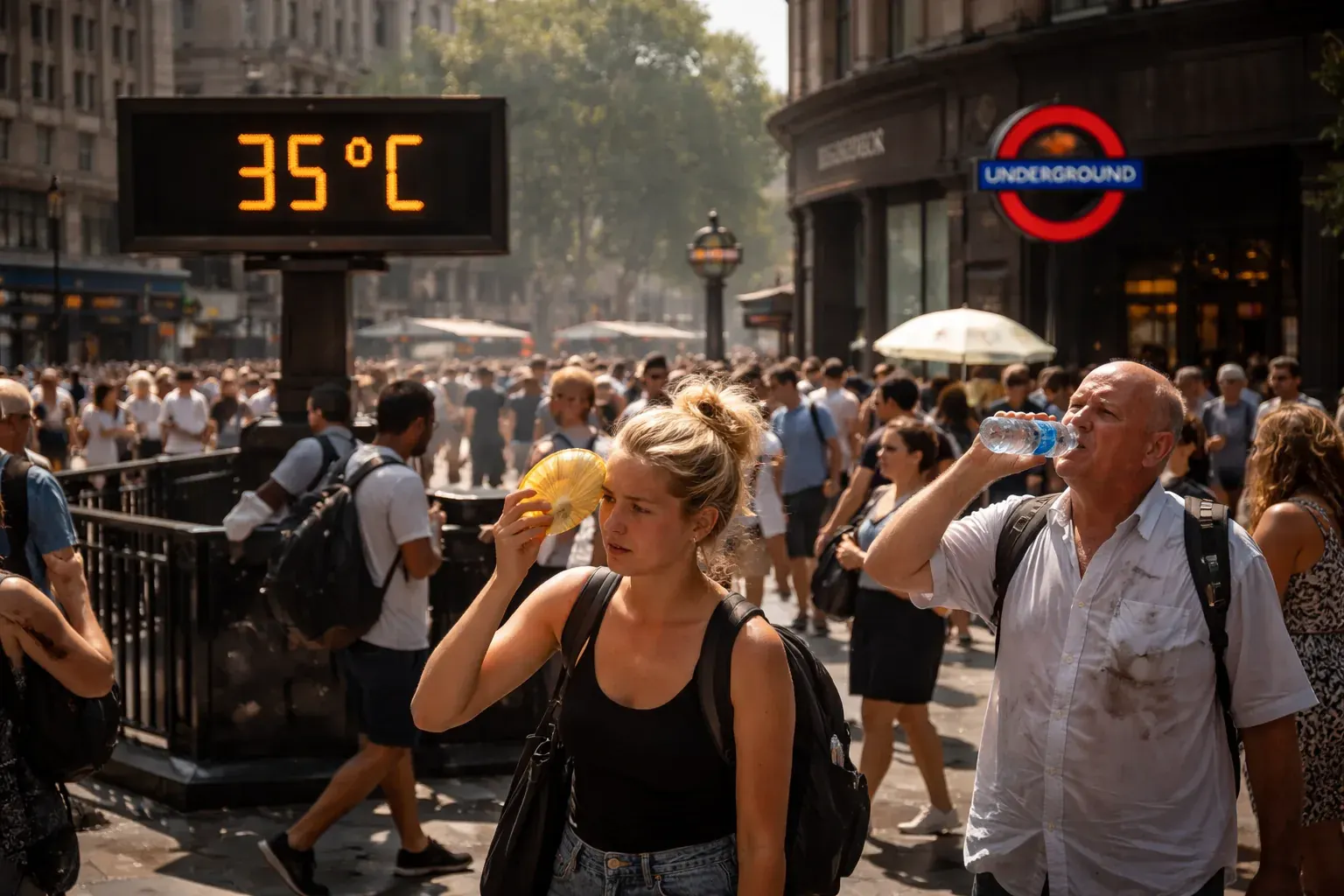
- Temperatures in the UK reached 35.1C this week, exceeding the previous May record by more than two degrees Celsius.
- Europe is warming at a rate of 0.56C per decade, which is more than twice the global average according to the Copernicus climate service.
- Scientists note that in a stable climate, records should be broken by small fractions, but current systems are 'smashing' benchmarks by several degrees.
What happened
Climate scientists are warning that the most unsettling part of recent heatwaves is not simply that records are being broken, but the scale by which they are being broken. In multiple regions, temperatures are not edging past old highs by tenths of a degree, as would be more typical in a relatively stable climate. They are surpassing them by one, two, or even several degrees, turning what should be rare outliers into signs of a climate system that is shifting fast enough to shock even experienced researchers.
The latest European and global heat events have therefore become more than seasonal weather stories. They are being treated as evidence that the background warming caused by fossil-fuel emissions is now large enough to supercharge ordinary meteorological patterns into record-smashing extremes.
What's new in this update
Scientists are emphasizing the margin of the records as a critical warning signal. A record broken by a small fraction can still be significant, but a record shattered by multiple degrees suggests that the baseline itself has moved dramatically. That is what researchers describe as "absurd" or "astonishing" in the current data: not just frequency, but the widening gap between previous climate expectations and present outcomes.
The example from the UK, where temperatures rose above prior May records by more than two degrees Celsius, illustrates the point clearly. Similar anomalies have appeared across Western Europe and in other parts of the world, reinforcing the view that this is not an isolated national event but part of a broader global pattern.
Key details
Meteorologically, many of these events are still driven by recognizable weather mechanisms such as heat domes, stagnant high-pressure systems, dry soils, and persistent warm-air transport. What climate change does is intensify the starting conditions and increase the odds that those familiar patterns produce unprecedented results. In other words, the weather system may be normal in type, but it is operating on a much hotter planet.
Several facts define the current concern:
- Europe is warming faster than the global average.
- Recent records are being broken by unusually large margins.
- Similar early-season extremes are appearing in multiple world regions.
- Scientists increasingly see these events as aligned with long-term warming projections, but alarming in intensity.
This is why the discussion has shifted from "did climate change cause this?" to "how much worse did climate change make this?"
Background and context
For decades, climate researchers warned that global warming would not simply raise average temperatures. It would also load the dice toward more intense heat extremes, earlier heatwaves, and a greater chance that records would fall in clusters. What now appears to be surprising some scientists is how dramatic the margins have become and how early in the warm season some of the worst anomalies are appearing.
Europe's sensitivity is especially important. The continent has seen rapid warming, urban heat amplification, and repeated deadly heat events in recent years. That means every new record is not just a statistical event. It has direct implications for mortality, agriculture, labor productivity, water systems, and infrastructure resilience.
What to watch next
The next critical question is whether this pattern continues deeper into the Northern Hemisphere summer. If early-season extremes are already smashing records, midsummer events could be even more dangerous, especially in regions where populations, buildings, and public-health systems are not prepared for sustained heat.
Researchers will also keep examining whether current climate models are fully capturing the pace and compound nature of these extremes, including land-surface feedbacks, drought interactions, and regional amplification effects.
Why this matters
This matters because climate change, global warming, meteorology, extreme weather, heatwaves, and Western Europe are all converging in a way that makes the old language of "record-breaking" almost too mild. When records are smashed by unprecedented margins, the signal is that the climate baseline itself is shifting into more dangerous territory. That has consequences not just for scientists and models, but for public health, infrastructure planning, and how governments prepare for a hotter world that is arriving faster than many people expected.
Reader context
This story belongs to Northstar Herald's world coverage, with related entities including Climate Change, Heatwave, Meteorology, Global Warming. The report is based on BBC World News source material.
Related coverage
Why it matters
The increasing margin of record-breaking temperatures suggests that climate change is supercharging standard weather systems, leading to more severe and early-season heat extremes.
Read next
Follow this story through the topic hub, more world coverage, and the latest updates.
Weekly briefing
Get the week's key developments in one concise email.
Get a fast catch-up on the biggest stories, the context behind them, and the links worth your time.
Cadence
Weekly, for a quick catch-up
Coverage
AI, business, world, security, sports
Format
Clear takeaways and useful context
Request the briefing
Leave your email to open a prepared request and get on the list for the weekly briefing.
About the byline
World correspondent
Leila Haddad covers world affairs, diplomacy, and humanitarian crises, with a focus on how fast-moving international developments affect public policy, conflict response, and cross-border institutions.
Sources and methodology