Vinton Cerf to Retire from Google, Warning of the Need for AI
The 'Father of the Internet' will step down next week, concluding a legendary career while offering a final vision for standardized, precise communication

AI reporter
Reports on model launches, frontier labs, developer platforms, and AI policy with an emphasis on claims verification and rollout context.
Editorial responsibility: Lead reviewer for AI coverage, launch claims, and policy context
Primary source: TechCrunch AI. Full source links and update notes are below.
Fast summary
Start here
- Vinton Cerf is retiring from Google on July 7, 2026, after serving more than 20 years as the company's chief internet evangelist.
- Cerf co-developed the TCP/IP protocols that form the foundational architecture of the global internet, earning him a Turing Award and the Presidential Medal of Freedom.
- During his final public appearance, Cerf emphasized that the future of agentic AI will require precise, standardized protocols rather than relying on ambiguous natural language.
What happened
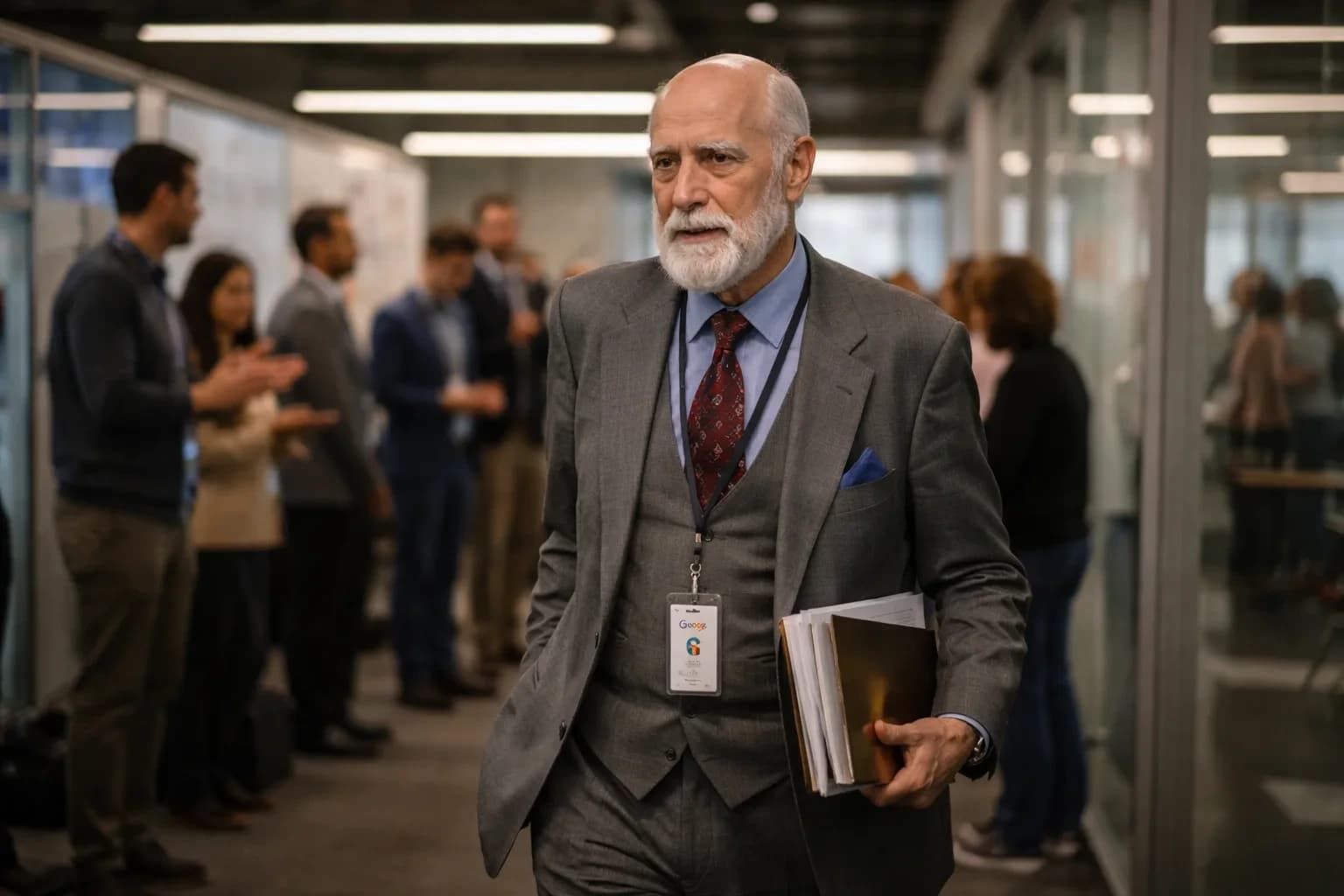
Vinton Cerf, widely regarded as one of the primary architects of the internet, is set to retire from his position at Google next week. The announcement came during the Open Frontier conference hosted by the Laude Institute, where Cerf was appearing via video feed to discuss the future of open-source infrastructure. His departure marks the end of a twenty-year tenure at the search giant, where he served as vice president and chief internet evangelist. During the event, UC Berkeley professor Dave Patterson, a pioneer in RISC architecture, led the room in a round of applause to honor Cerf’s influential career. While Google has not yet issued a formal statement regarding the retirement, the transition signifies the conclusion of an era for one of the most visible and respected figures in the history of computer science. Cerf’s departure comes at a pivotal moment as the technology landscape shifts from traditional networking toward integrated artificial intelligence systems.
What's new in this update
Beyond the retirement news, Cerf used his appearance to provide a forward-looking critique of the current state of artificial intelligence development. He specifically addressed the rise of agentic AI—software systems capable of acting autonomously and coordinating with other software. Cerf predicted that the increasing complexity of these 'agentic models,' where multiple AI agents from various sources must interact, will eventually force a return to the principles of composability and standardization. He suggested that the industry is currently repeating history, mirroring the early 'protocol wars' of the pre-internet era. As founders and engineers bet on open infrastructure for the next generation of AI products, Cerf argued that the decentralization that made his original internet protocols so durable must be replicated to ensure that AI agents can communicate effectively across different platforms and providers without centralized bottlenecks.
Key details
One of Cerf's most significant contributions to the discussion was his skepticism regarding the use of natural language as the primary medium for interaction between AI agents. While some panelists at the conference suggested that Large Language Models (LLMs) could communicate effectively using English, Cerf warned that such a reliance would be 'terrifying.' He pointed to the inherent ambiguity and flexibility of human language as a major risk factor, comparing it to the 'telephone game' where messages are distorted as they pass through multiple hands. Instead, Cerf advocated for formal, precise standards for inter-agent interaction. He argued that for an agent to be truly effective, it must have absolute certainty that another agent understands the specific parameters of an agreement or task. This precision is, in his view, a prerequisite for the 'agentic economy' to function reliably and safely on a global scale.
Background and context
Vinton Cerf’s legacy is built on work that began in the 1970s. Alongside Robert Kahn, he developed Transmission Control Protocol and Internet Protocol (TCP/IP), the foundational rules that allow disparate computer networks to interconnect. This breakthrough earned him the A.M. Turing Award—often called the 'Nobel Prize of Computing'—as well as the Presidential Medal of Freedom. Since joining Google in 2005, Cerf has been a tireless advocate for internet expansion, digital rights, and the maintenance of open standards. His presence at the Open Frontier conference alongside other luminaries, such as Keras creator François Chollet and Databricks technologist Matei Zaharia, underscored his continued relevance in modern software debates. Known for his signature three-piece suits even in the casual tech world of the 1970s, Cerf has remained a consistent voice for professional rigor and architectural elegance in a rapidly evolving field.
What to watch next
As Cerf steps away from his day-to-day role at Google, the tech industry faces a critical crossroads regarding AI interoperability. The 'agentic model' he described is already beginning to take shape through projects at major labs and within the open-source community. Observers will be watching to see if the major players in AI—such as Google, OpenAI, and Anthropic—will heed Cerf’s call for standardized protocols or if they will continue to build 'walled gardens' around their proprietary models. The outcome of this struggle will likely determine whether the next phase of the digital economy remains as decentralized and accessible as the original internet or if it becomes increasingly siloed. Cerf’s final warning suggests that the companies defining these interoperability standards today will hold the same level of influence as those who established the early protocols of the World Wide Web, potentially shaping the digital landscape for decades to come.
Why it matters
As the co-creator of the protocols that power the modern world, Cerf's departure marks the end of an era and signals a critical need for new standards to manage the next wave of autonomous AI systems.
Read next
Follow this story through the topic hub, more ai coverage, and the latest updates.
Weekly briefing
Get the week's key developments in one concise email.
Get a fast catch-up on the biggest stories, the context behind them, and the links worth your time.
Cadence
Weekly, for a quick catch-up
Coverage
AI, business, world, security, sports
Format
Clear takeaways and useful context
Request the briefing
Leave your email to open a prepared request and get on the list for the weekly briefing.
About the byline
AI reporter
Alex Rivera reports on artificial intelligence with an emphasis on model launches, frontier lab strategy, developer tooling, and the policy decisions shaping commercial deployment.
Sources and methodology