SpaceXAI Releases Grok 4.5 as High-Efficiency Opus-Class AI Model
SpaceXAI debuts Grok 4.5, a high-efficiency model designed to rival Anthropic's Opus 4.7 with significant cost savings and faster processing speeds.

AI reporter
Reports on model launches, frontier labs, developer platforms, and AI policy with an emphasis on claims verification and rollout context.
Editorial responsibility: Lead reviewer for AI coverage, launch claims, and policy context
Primary source: TechCrunch AI. Full source links and update notes are below.
Fast summary
Start here
- SpaceXAI released Grok 4.5, its first major model update since the company's recent initial public offering several weeks ago.
- The model is positioned as an Opus-class competitor, offering performance comparable to Anthropic’s flagship while maintaining higher speeds.
- Pricing for Grok 4.5 is set at $2 per million input tokens and $6 per million output tokens, significantly undercutting top-tier rivals.
What happened
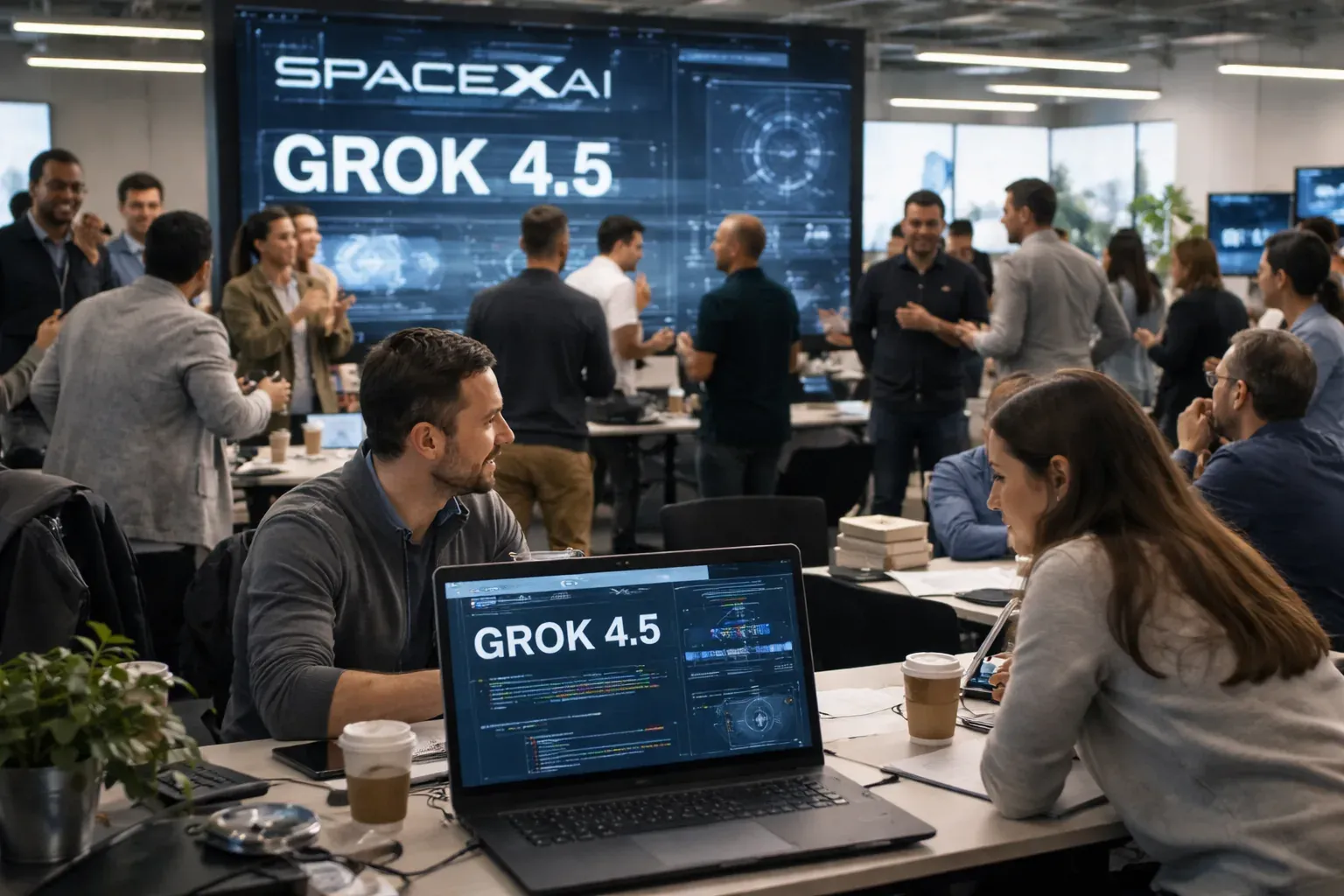
SpaceXAI has officially released Grok 4.5, marking a significant milestone as the first major artificial intelligence model launch since the company’s recent public offering. Founder Elon Musk described the new model as an Opus-class system, a direct reference to the high-performance tiers of models produced by competitor Anthropic. In a blog post published on Wednesday, the company positioned Grok 4.5 as a versatile workhorse capable of handling intensive knowledge work, including complex coding, application development, and advanced research. The release comes at a pivotal moment for the AI industry, which is increasingly focused on the transition from experimental tools to reliable enterprise-grade automation. By launching Grok 4.5 now, SpaceXAI aims to capture market share among businesses looking for robust performance without the prohibitive costs typically associated with the industry's most powerful large language models.
What's new in this update
The defining feature of Grok 4.5 is its claimed leap in operational efficiency. SpaceXAI asserts that the model delivers twice greater token efficiency than other leading models in its class. This efficiency is not just a technical metric; it translates directly into faster processing speeds and lower latency for end-users. Elon Musk highlighted these improvements on his social media platform X, stating that while the model is comparable in capability to Anthropic’s Opus 4.7, it operates at a much higher velocity. This focus on speed and efficiency addresses a primary pain point for developers and enterprises who find that current top-tier models often trade performance for sluggish response times. Furthermore, the model is designed to excel in routine knowledge tasks, such as clerical work and technical writing, providing a more streamlined experience for professional users.
Key details
In terms of economics, SpaceXAI has introduced highly competitive pricing for Grok 4.5. The model is priced at $2 per million input tokens and $6 per million output tokens. For context, this pricing structure significantly undercuts Anthropic’s Opus 4.7, which carries a cost of $5 per million input tokens and $25 per million output tokens. Even when compared to OpenAI’s tiered pricing, Grok 4.5 remains a strong contender. While OpenAI’s budget-friendly Luna model is cheaper at $1 per million input tokens, its premium Sol model is far more expensive at $5 per million input tokens. Internal benchmarks released by SpaceXAI show that while Grok 4.5 may fall slightly short of being best-in-class in raw capability, its balance of speed and cost makes it a compelling alternative for large-scale deployments.
Background and context
The release of Grok 4.5 occurs within a broader surge of activity across the generative AI sector. It arrives just one day before OpenAI is scheduled to release GPT 5.6, its most powerful model to date. The timing suggests an intensifying rivalry between the major AI labs as they race to define the next generation of machine learning capabilities. Previously, the release of high-powered models like GPT 5.6 had faced delays due to security concerns raised by the Trump administration regarding national security implications. SpaceXAI’s move to go public several weeks ago also provides a backdrop of increased financial scrutiny and expectation. As a public entity, SpaceXAI must now prove that its technology can not only innovate but also achieve commercial viability in a crowded market where investors are looking for clear returns on AI investment.
What to watch next
Industry observers are now looking to the public release of Grok 4.5, scheduled for Thursday, to see if real-world performance aligns with SpaceXAI’s internal benchmarks and rhetoric. The true test will be how the model handles diverse enterprise workloads compared to the upcoming GPT 5.6 and existing models from Anthropic and Google. As token costs continue to be a primary concern for AI consumers, the success of Grok 4.5 could force competitors to reconsider their own pricing strategies. Additionally, the broader regulatory environment remains a critical factor; as AI models become more powerful, government oversight regarding security and safety is expected to tighten. Whether SpaceXAI can maintain its aggressive release schedule while navigating these regulatory and competitive pressures will be the defining story of its first year as a public company.
Why it matters
The launch signals SpaceXAI's intent to dominate the enterprise AI market by focusing on cost-efficiency and speed, challenging premium pricing.
Read next
Follow this story through the topic hub, more ai coverage, and the latest updates.
Weekly briefing
Get the week's key developments in one concise email.
Get a fast catch-up on the biggest stories, the context behind them, and the links worth your time.
Cadence
Weekly, for a quick catch-up
Coverage
AI, business, world, security, sports
Format
Clear takeaways and useful context
Request the briefing
Leave your email to open a prepared request and get on the list for the weekly briefing.
About the byline
AI reporter
Alex Rivera reports on artificial intelligence with an emphasis on model launches, frontier lab strategy, developer tooling, and the policy decisions shaping commercial deployment.
Sources and methodology