ArXiv to Suspend Authors for Submitting Unchecked AI-Generated
The preprint repository will implement a one-year ban for papers containing incontrovertible evidence of unvetted large language model usage.

AI reporter
Reports on model launches, frontier labs, developer platforms, and AI policy with an emphasis on claims verification and rollout context.
Editorial responsibility: Lead reviewer for AI coverage, launch claims, and policy context
Primary source: TechCrunch AI. Full source links and update notes are below.
Fast summary
Start here
- Authors face a one-year suspension if a submission shows clear signs of unchecked AI generation, such as hallucinated citations or residual LLM prompts.
- Following a ban, researchers must have subsequent papers accepted by a peer-reviewed venue before they can post to ArXiv again.
- The policy focuses on author accountability for content accuracy rather than an outright prohibition of AI tools.
What happened
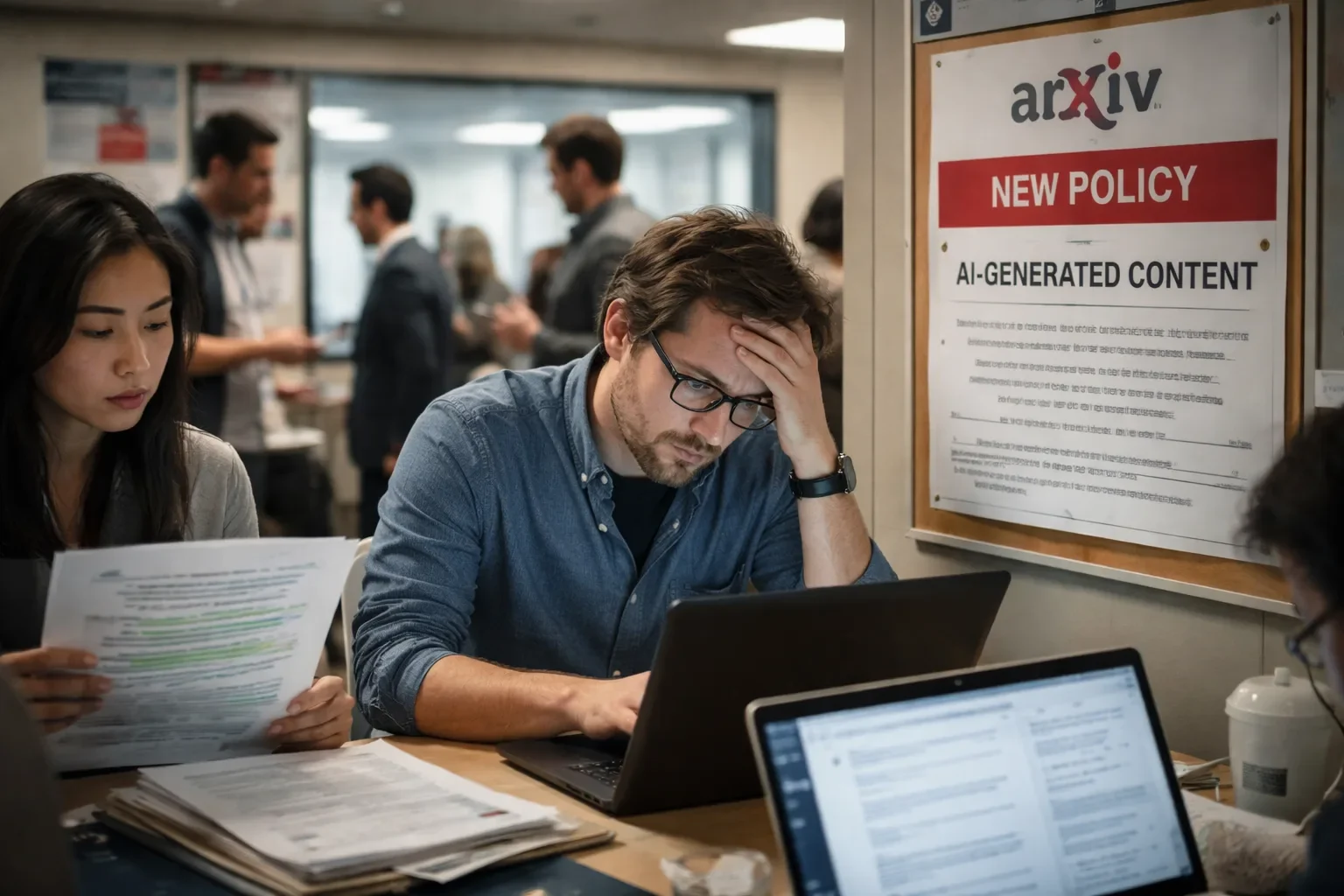
ArXiv is preparing to impose one-year suspensions on authors who submit papers containing clear evidence of unchecked AI-generated content, including hallucinated references, leftover chatbot prompts, or other signs that a large language model produced material the authors failed to verify. The move does not ban researchers from using AI tools outright. Instead, it makes a stronger institutional claim: if authors use AI, they remain fully responsible for every factual, stylistic, and scholarly defect that slips through.
That is a meaningful change for one of the most important preprint repositories in the world. ArXiv has long operated on speed, openness, and community norms. This policy signals that the platform now sees unvetted AI-generated research as serious enough to justify formal exclusion rather than gentle correction.
What's new in this update
The most consequential part of the policy is not only the one-year ban itself, but the post-ban requirement. Researchers who are suspended will reportedly need to regain trust by having later work accepted at a peer-reviewed venue before ArXiv will host their submissions again. That means the repository is not just trying to punish careless AI use. It is trying to create a reputational filter that restores confidence after a demonstrated breach of academic responsibility.
The standard for enforcement also matters. ArXiv says it will look for "incontrovertible evidence" of unchecked AI content rather than trying to police every invisible use of language models. That suggests the repository wants a policy that is enforceable and defensible, not a vague anti-AI posture that would be impossible to apply fairly.
Key details
The examples driving concern are familiar to anyone following AI in academic writing: fabricated citations, imaginary sources, malformed reasoning chains, and residual prompt text that accidentally exposes the paper's synthetic origin. Those errors are especially dangerous in preprint culture because ArXiv content spreads quickly through research communities before formal peer review has the chance to catch mistakes.
Several features define the new approach:
- AI use is not banned, but unchecked AI output becomes a sanctionable offense.
- Suspensions last one year for qualifying cases.
- Re-entry after a ban requires stronger evidence of legitimacy through peer-reviewed acceptance.
- Responsibility remains with the authors regardless of what tool produced the error.
This is why the policy is best understood as a governance move, not merely a moderation tweak. ArXiv is redefining the accountability expectations of preprint publishing in the AI era.
Background and context
ArXiv occupies a uniquely important role in computer science, mathematics, physics, and adjacent fields because it allows research to circulate quickly and shape discussion before journal publication. That speed is one of its great strengths, but it also makes the repository vulnerable to low-quality or misleading submissions. As large language models make it easier to generate academic-sounding text at scale, the risk is not only fraud in the dramatic sense. It is also a slow degradation of trust through careless, plausible-looking nonsense.
This issue has become especially visible in fast-moving technical domains where AI tools are both widely used and widely discussed. A repository central to AI research is therefore being forced to defend itself against the side effects of the very technologies many of its authors are building.
What to watch next
The next major question is whether other preprint servers, journals, and conference organizers adopt similarly explicit penalties. If ArXiv's policy proves workable, it could become a model for broader scientific publishing norms around AI-assisted writing. If it triggers disputes over evidence, fairness, or false accusation, the debate may shift toward how to distinguish legitimate assistance from negligent outsourcing of scholarly judgment.
Another issue is tool sophistication. As AI outputs become harder to identify, overt traces such as hallucinated citations may become less common, pushing platforms toward more resource-intensive review practices.
Why this matters
This matters because ArXiv, scientific publishing, academic integrity, LLMs, and the future of research communication are all converging around a basic question: what happens when the easiest way to produce scholarly-looking text is not the same as the hardest part of scholarship, which is knowing whether the content is true? By threatening year-long bans, ArXiv is saying that speed cannot come at the cost of trust. For a repository that sits at the center of modern technical research, that is a major line to draw.
Reader context
This story belongs to Northstar Herald's Generative AI and Artificial Intelligence coverage, with related entities including ArXiv, Scientific Publishing, Academic Integrity, LLMs. The report is based on TechCrunch AI source material.
Related coverage
Why it matters
As a primary hub for computer science and math research, ArXiv's integrity is vital for scientific progress; this crackdown addresses the rising risk of 'AI slop' in academic literature.
Read next
Follow this story through the topic hub, more ai coverage, and the latest updates.
Weekly briefing
Get the week's key developments in one concise email.
Get a fast catch-up on the biggest stories, the context behind them, and the links worth your time.
Cadence
Weekly, for a quick catch-up
Coverage
AI, business, world, security, sports
Format
Clear takeaways and useful context
Request the briefing
Leave your email to open a prepared request and get on the list for the weekly briefing.
About the byline
AI reporter
Alex Rivera reports on artificial intelligence with an emphasis on model launches, frontier lab strategy, developer tooling, and the policy decisions shaping commercial deployment.
Sources and methodology