Apple Overhauls Siri as a Conversational AI Companion
The long-awaited update introduces a dedicated app, deeper device context, and system-wide writing tools to compete with modern chatbots.

AI reporter
Reports on model launches, frontier labs, developer platforms, and AI policy with an emphasis on claims verification and rollout context.
Editorial responsibility: Lead reviewer for AI coverage, launch claims, and policy context
Primary source: TechCrunch AI. Full source links and update notes are below.
Fast summary
Start here
- Siri has been rebranded as 'Siri AI,' transitioning from a voice assistant to a conversational chatbot capable of text-based interaction.
- A new 'Write with Siri' feature allows the assistant to draft messages and emails based on the user's specific communication style and context.
- The assistant now resides in the Dynamic Island and can access on-screen information to provide more relevant, grounded answers.
What happened
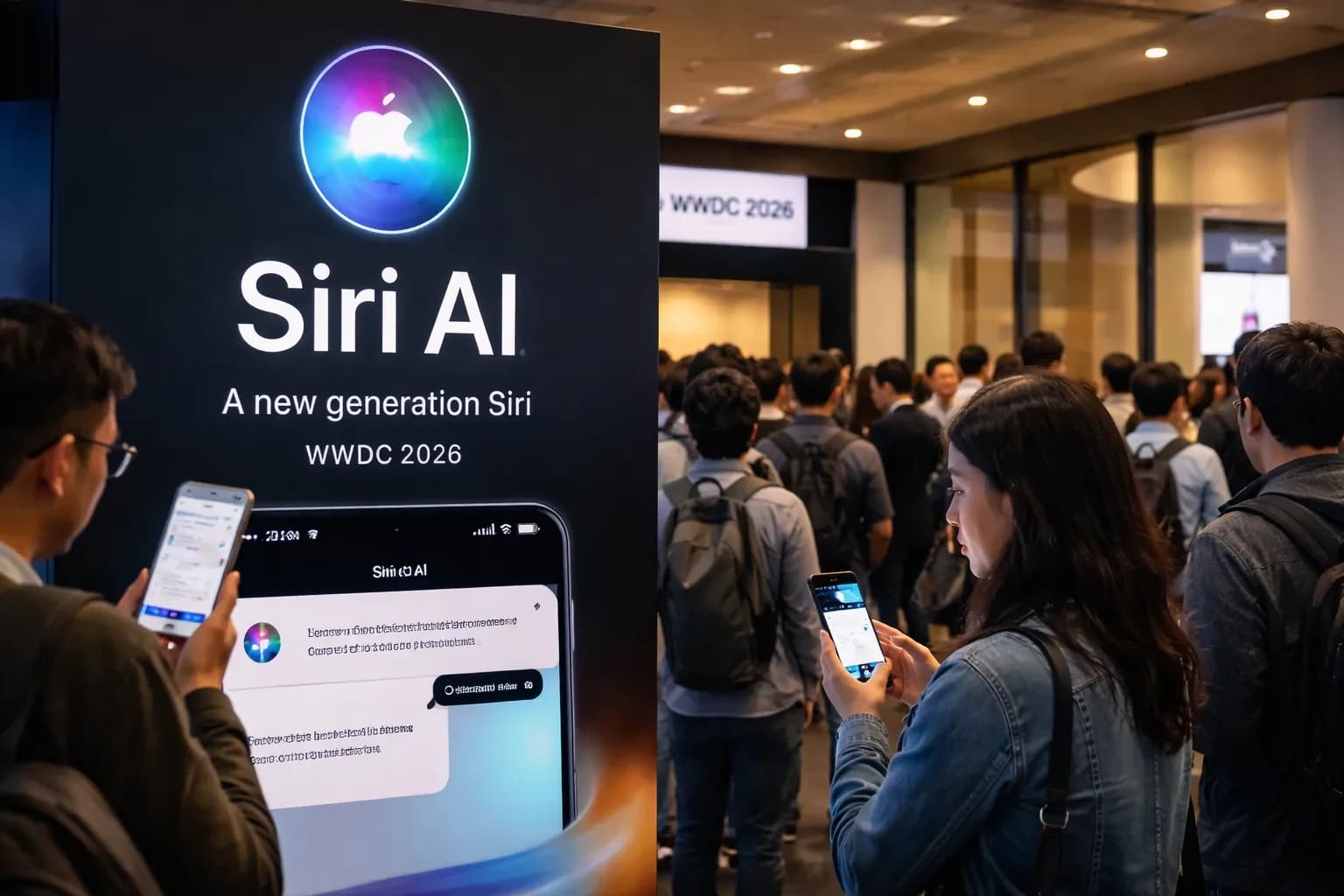
Apple used WWDC 2026 to present its most extensive Siri redesign in years, recasting the assistant as "Siri AI" and positioning it as a conversational, context-aware tool rather than a limited voice command layer. The update includes a dedicated interface, tighter integration with the Dynamic Island, broader text input options, and deeper access to on-device context so Siri AI can respond more like a modern chatbot while remaining embedded inside Apple's operating systems.
This matters because Siri has long been one of Apple's weakest links in the AI conversation. For years, the assistant lagged behind newer systems that could handle multi-step prompts, natural back-and-forth conversation, and richer contextual reasoning. WWDC 2026 was Apple's attempt to reset that perception.
Why the Siri AI rebrand matters
The naming alone tells a story. Calling the system "Siri AI" signals that Apple wants users to understand this as something materially different from the assistant they already knew. This is not just a visual refresh or a faster voice parser. Apple is trying to reposition Siri as part of the same competitive category as ChatGPT, Gemini, and other conversational assistants that have reset consumer expectations.
That shift is necessary because the old Siri brand had become associated with limitation. A rebrand gives Apple room to tell users that the product has changed at a deeper level.
The dedicated app and Dynamic Island strategy
One of the most notable design choices is that Siri AI is no longer confined to the classic invocation model. A dedicated app and Dynamic Island presence suggest Apple wants the assistant to feel persistently available rather than episodic. That is strategically important. Modern AI assistants become more useful when users can move fluidly between voice, text, and quick follow-up actions without restarting the interaction each time.
The Dynamic Island placement also matters symbolically. Apple is giving Siri AI premium screen real estate, which signals that the assistant is no longer peripheral to the iPhone experience.
Why context access changes the product
The deeper promise behind Siri AI is contextual grounding. Apple says the assistant can work with personal information, on-screen content, and device-level signals to produce more relevant answers and actions. If that works reliably, Siri AI could become much more useful than a generic chatbot because it would understand the user's environment rather than only the raw prompt.
This is the core competitive idea. Many AI systems are impressive in isolation. Apple wants Siri AI to be impressive because it is woven into iPhone, iPad, Mac, and Watch workflows.
The importance of "Write with Siri"
Apple's writing features are another key part of the strategy. "Write with Siri" brings generative assistance into messaging and email tasks where users can see immediate practical value. That matters because mainstream adoption of AI often depends less on headline demos and more on whether the feature saves time inside routine behavior.
Writing help also gives Apple a cleaner on-ramp for AI usage. Not every user wants a chatbot conversation, but many users will accept help drafting, editing, or rephrasing messages if it feels native and trustworthy.
The pressure Apple is under
This overhaul also reflects competitive pressure. OpenAI, Google, Anthropic, and Microsoft have pushed the market toward a new baseline for what assistants are expected to do. Apple could not afford another year of seeming passive while rivals defined the consumer AI experience. Siri AI is therefore both a product launch and a credibility repair effort.
That does not mean Apple needs to copy competitors exactly. But it does need to prove that its own assistant can participate in the same class of tasks without feeling dated.
What to watch next
The biggest question is real-world performance. Demo environments are controlled, but users will judge Siri AI on follow-up accuracy, speed, reliability, and whether privacy protections hold up while the assistant gains access to more contextual information. Adoption across macOS, iOS, and watchOS will also matter because Apple's long-term advantage depends on ecosystem consistency.
For now, Apple's comprehensive Siri AI overhaul at WWDC 2026 is important because it finally acknowledges the scale of the assistant problem and attempts a serious correction. The company is betting that conversational AI, device context, and system-level utility can turn Siri from a legacy assistant into a credible part of the modern AI race.
Why it matters
This overhaul represents Apple's direct response to generative AI leaders like OpenAI and Google, aiming to modernize its ecosystem with more capable, context-aware utility.
Read next
Follow this story through the topic hub, more ai coverage, and the latest updates.
Weekly briefing
Get the week's key developments in one concise email.
Get a fast catch-up on the biggest stories, the context behind them, and the links worth your time.
Cadence
Weekly, for a quick catch-up
Coverage
AI, business, world, security, sports
Format
Clear takeaways and useful context
Request the briefing
Leave your email to open a prepared request and get on the list for the weekly briefing.
About the byline
AI reporter
Alex Rivera reports on artificial intelligence with an emphasis on model launches, frontier lab strategy, developer tooling, and the policy decisions shaping commercial deployment.
Sources and methodology