Alibaba to Restrict Employee Access to Anthropic’s Claude Code
The Chinese tech giant has reportedly classified the AI programming assistant as high-risk, mandating a transition to the company’s internal Qoder tool.

AI reporter
Reports on model launches, frontier labs, developer platforms, and AI policy with an emphasis on claims verification and rollout context.
Editorial responsibility: Lead reviewer for AI coverage, launch claims, and policy context
Primary source: TechCrunch AI. Full source links and update notes are below.
Fast summary
Start here
- Alibaba will enforce a ban on Anthropic’s Claude Code for all employees starting on July 10.
- Anthropic recently confirmed past experiments designed to identify and block unauthorized Chinese users of its models.
- Employees at Alibaba are being instructed to use the firm's proprietary Qoder tool as a secure alternative for coding assistance.
What happened
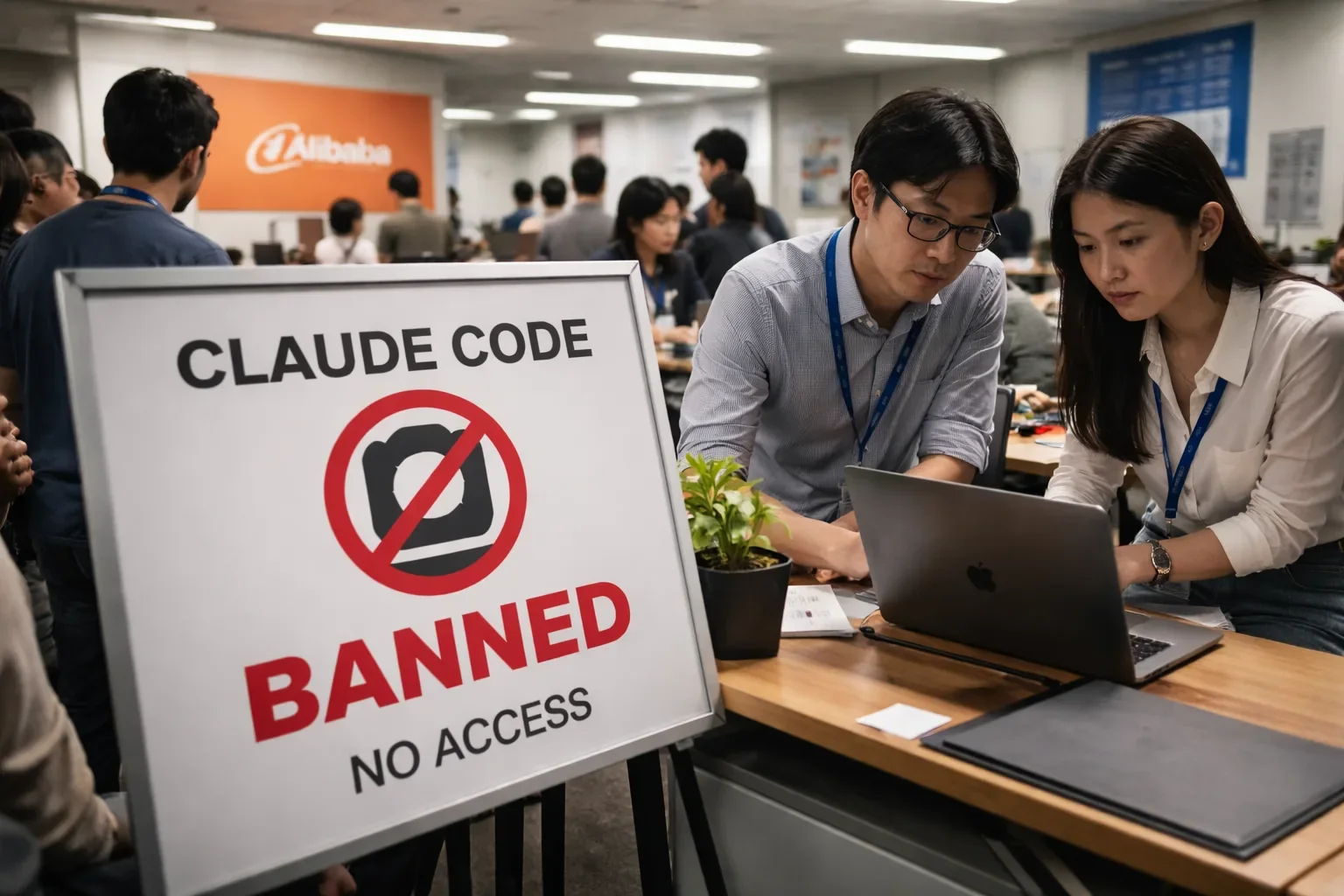
Alibaba, the Chinese multinational technology conglomerate, has reportedly issued an internal directive banning its employees from using Claude Code, a specialized programming tool developed by the U.S.-based AI startup Anthropic. According to multiple reports, the ban is set to take effect on July 10, 2026. This decision marks a significant shift in the company’s developer policy, as it classifies the third-party AI software as 'high-risk.' The restriction follows a pattern of heightened internal security measures at large Chinese tech firms seeking to protect their proprietary source code and data from being processed by external, foreign-hosted Large Language Models. In place of Claude Code, Alibaba is directing its workforce to utilize its own internal solution, known as 'Qoder,' which is designed to provide similar generative coding capabilities within the company’s secure infrastructure.
What's new in this update
The timing of the ban appears to be linked to recent disclosures regarding how Anthropic manages its geographic restrictions. Anthropic already officially prohibits Chinese companies, as well as foreign entities owned by those companies, from accessing its models. However, new reports and social media discussions have highlighted recent efforts by Anthropic to close existing loopholes that allowed Chinese users to bypass these blocks. Specifically, a recent experiment conducted by Anthropic involved a version of Claude Code that could reportedly identify Chinese users. Thariq Shihipar, a representative from Anthropic, addressed these reports on the platform X, explaining that the company launched an experiment in March 2026 to prevent account abuse from unauthorized resellers and to protect the company's intellectual property against model 'distillation'—a practice where AI outputs are used to train competing models.
Key details
Alibaba’s classification of Claude Code as 'high-risk' suggests that the company is concerned about more than just simple compliance with U.S. export laws. By labeling the software in this manner, Alibaba’s security team is signaling that the use of such tools could lead to the exposure of sensitive internal logic or the potential for external monitoring of their developers' activities. While Anthropic has stated that it has since implemented 'stronger mitigations' and intended to retire the user-identification experiment for some time, the incident has highlighted the lack of trust between Chinese tech giants and American AI labs. The transition to the 'Qoder' tool is part of a broader push toward technological self-sufficiency, ensuring that the productivity gains offered by generative AI do not come at the expense of data sovereignty.
Background and context
The relationship between Western AI developers and Chinese tech entities has been fraught with tension as the U.S. government continues to tighten restrictions on the export of advanced AI hardware and software. Anthropic, which was founded by former OpenAI executives and has received significant investment from major tech firms, has consistently maintained that its services are not intended for use in China. Despite these policies, a thriving secondary market of unauthorized resellers has often provided access to restricted models through various technical workarounds. For Alibaba, which operates extensive cloud and e-commerce networks, maintaining an independent AI stack is a matter of national and corporate security. The company has invested heavily in its own generative AI models, such as the Tongyi Qianwen series, to compete on the global stage while adhering to domestic regulatory requirements.
What to watch next
As the July 10 deadline for the Alibaba ban approaches, industry analysts will be watching to see if other major Chinese tech players—such as Tencent, Baidu, or ByteDance—implement similar formal restrictions on Western AI tools. The move by Alibaba could set a precedent for a more aggressive 'clean software' initiative within the Chinese corporate sector. Furthermore, the development and performance of 'Qoder' will be a key metric for Alibaba’s internal efficiency; if the proprietary tool can successfully replace Claude Code without a drop in developer productivity, it will further validate the strategy of decoupling from foreign AI dependencies. Meanwhile, Anthropic and other U.S.-based labs are likely to continue refining their geo-fencing technologies to prevent unauthorized usage, potentially leading to more friction in the international developer community.
Why it matters
This move highlights the increasing fragmentation of the global AI market as corporate security concerns and geopolitical restrictions force major tech firms to abandon foreign software in favor of domestic alternatives. It also underscores the technical challenges AI labs face in preventing unauthorized cross-border access to their models.
Read next
Follow this story through the topic hub, more ai coverage, and the latest updates.
Weekly briefing
Get the week's key developments in one concise email.
Get a fast catch-up on the biggest stories, the context behind them, and the links worth your time.
Cadence
Weekly, for a quick catch-up
Coverage
AI, business, world, security, sports
Format
Clear takeaways and useful context
Request the briefing
Leave your email to open a prepared request and get on the list for the weekly briefing.
About the byline
AI reporter
Alex Rivera reports on artificial intelligence with an emphasis on model launches, frontier lab strategy, developer tooling, and the policy decisions shaping commercial deployment.
Sources and methodology